
Single Barrel vs. Small Batch Bourbon: Why Honey Barrels Vary & What Collectors Hunt
The exact cooperage and rickhouse science separating Single Barrel bourbon from Small Batch—why two bottles of the same Single Barrel label can taste completely different.
Table of Contents
Stand in front of the top shelf at any serious whiskey shop and you will see two terms embossed in gold leaf across almost every premium bourbon label: Small Batch and Single Barrel.
Many buyers assume "Single Barrel" is simply a marketing upgrade over "Small Batch." In reality, the two represent opposite philosophies of whiskey making: one is the art of consistency through master blending, while the other is a one-of-a-kind snapshot of a single oak cask that will never be replicated again once those ~180 bottles are gone.
In this collector's guide, we decode how rickhouse microclimates create legendary "honey barrels," why two bottles of the exact same Single Barrel bourbon can taste wildly different, and when to reach for each in your tasting room.
What Is Small Batch Bourbon? (The Art of the Master Blender)
Despite the name, "Small Batch" has no strict federal legal definition in the United States. Depending on the distillery, a small batch can mingle anywhere from 10 barrels (like Elijah Craig Barrel Proof batches or E.H. Taylor Small Batch) up to 200+ barrels.
Why Master Distillers Blend Small Batches:
- Symmetry & Balance: Barrels aged on the scorching top floor of a Kentucky rickhouse become dark, tannic, and high-proof, while barrels on the cool, damp bottom floor stay softer, sweeter, and floral.
- The Mingling Magic: By mingling high-floor oak monsters with middle-floor caramel barrels, a Master Blender builds a multi-layered chord of flavor that no single barrel could achieve alone—and guarantees that a bottle bought in 2026 tastes just as balanced as one bought in 2024.
What Is Single Barrel Bourbon? (The Hunt for "Honey Barrels")
Every bottle of Single Barrel (SiB) bourbon—such as Blanton's Single Barrel, Four Roses Single Barrel, Russell's Reserve Private Barrel Selection, or Henry McKenna 10-Year Bottled-in-Bond—comes from one individual 53-gallon charred white oak barrel, never mingled with any other whiskey.
Why Two Barrels Side-by-Side Taste Different:
- Individual Oak Tree Genetics: Even staves cut from the same forest have different wood grain density, sap sugar levels, and natural vanillin concentrations.
- Rickhouse Microclimates: A barrel resting next to a sunny southern window experiences wider summer/winter breathing cycles than a barrel 15 feet away in the shaded center rack.
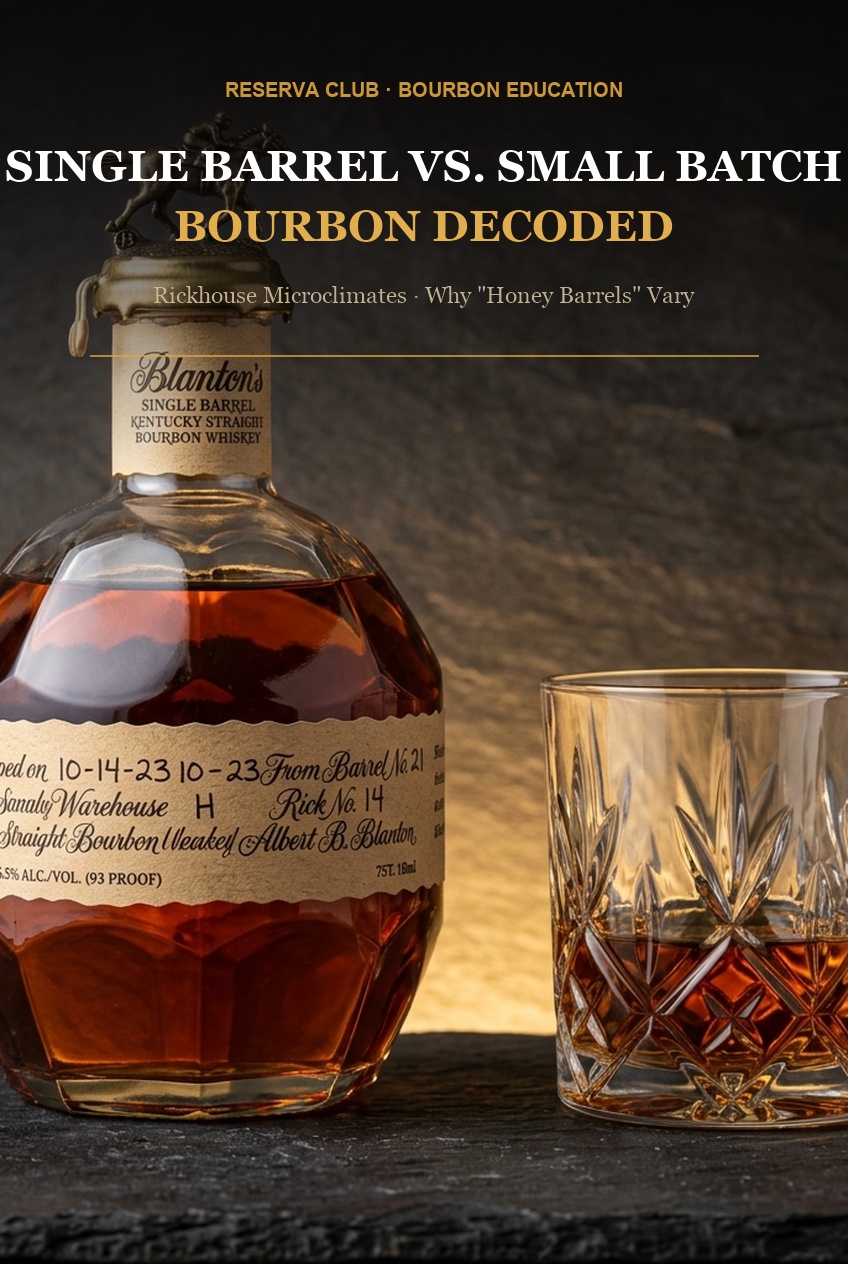
- Private "Store Picks": When a liquor store, bourbon club, or lounge visits Kentucky to taste through 6 barrels and buys one entire cask, those bottles carry a custom neck medallion with the exact Rickhouse, Floor, Age, and Barrel Number.
Head-to-Head Comparison Matrix
| Characteristic | Small Batch Bourbon | Single Barrel Bourbon |
|---|---|---|
| Cask Source | Mingled from 10 to 200+ selected barrels | Bottled from 1 individual 53-gallon barrel (~150–220 bottles) |
| Flavor Goal | Consistency, layered complexity, zero rough edges | Unique personality, peak "honey barrel" highs, terroir |
| Bottle-to-Bottle Variance | Near Zero (consistent house profile) | Moderate to High (each barrel is a 1-of-1 fingerprint) |
| Iconic Examples | E.H. Taylor Small Batch, Michter's US*1 Small Batch, Knob Creek 9, Woodford Reserve | Blanton's SiB, Four Roses SiB, Russell's Reserve SiB, Jack Daniel's Single Barrel Barrel Proof |
| Best Use Case | Reliable cigar pairing benchmark & daily anchor pour | Side-by-side blind flights & hunting private store picks |
How to Taste Single Barrel Variations Side-by-Side
One of the most rewarding experiments a bourbon collector can host is pouring two different barrel numbers of the same Single Barrel label (for example, two different store picks of Russell's Reserve or Four Roses) into matching Glencairn Crystal Tasting Glasses. You will immediately smell how one barrel leans toward dark cherry and baking spice while its sister barrel leans toward butterscotch and toasted oak.
Track Barrel Numbers, Rickhouses & Store Picks in Reserva Club
Never forget which barrel number or store pick was your favorite "honey barrel." Scan your bottles into Reserva Club to log rickhouse locations, proof, purchase prices, and live secondary valuations for free.
More from The Codex
Corojo vs. Habano Wrapper Cigars: Decoding Red Pepper vs. Cedar Spice & Bourbon Pairings
Read Guide →How to Order a 4-Pour Bourbon Flight: Why Proof & Finish Sequence Matters
Read Guide →Why Cigar Wrappers Crack & Split Mid-Smoke (And How to Stop Humidity Shock)
Read Guide →Double-Oaked vs. Toasted Barrel Bourbon: Woodford Double Oaked, Old Forester 1910 & Cigar Pairings
Read Guide →The Cameroon Wrapper Guide: Why African Tooth & Baking Spice Love High-Rye Bourbon
Read Guide →Never Smoke Right Off the Truck: The 14-Day Mail-Call Cigar Rest Protocol
Read Guide →
Smoke · Sip · Savor
Track your bottles, fill levels, infinity blends, and real street valuation.
Open My Whiskey Shelf →Reserva Club is reader-supported. When you purchase through links on our site, we may earn an affiliate commission at no extra cost to you. As an Amazon Associate, we earn from qualifying purchases.