
How to Calibrate a Digital Hygrometer: The 75% Salt Test vs. Boveda One-Step
Why factory-calibrated hygrometers lie by 4-8% RH. The chemical equilibrium of NaCl salt slurry, temperature coefficients, and the step-by-step 24-hour calibration protocol.
Table of Contents
- The Physics of Humidity Measurement: Analog vs. Digital Sensors
- The Chemistry of the 75% Salt Slurry Test
- Step-by-Step: The 24-Hour Salt Calibration Protocol
- The Alternative: Boveda One-Step Calibration Kit
- Digital Sensor Maintenance & Recalibration Cadence
- Setting Your Humidor Target: Beyond the 70/70 Myth
- Recommended Connoisseur Gear & Calibration Hardware
- Frequently Asked Questions
- Log Your Cellar Metrics with Reserva Club

A hygrometer is the heartbeat of your humidor, yet right out of the retail box, roughly 90% of digital hygrometers are lying to you.
Whether you paid $15 on Amazon or $80 for a machined brass instrument, consumer sensors leave the factory with component tolerances of ±4% to ±8% Relative Humidity (RH). If your hygrometer reads a cozy 68% RH while your humidor is actually sitting at 61%, your expensive Churchill vitolas will gradually shed their essential oils, resulting in a hot, papery, bitter draw. Conversely, if your sensor underreports humidity and your actual cellar reaches 73% RH in warm summer months, you are setting the stage for devastating mold outbreaks and tobacco beetle larvae hatching.
Accurate humidor management does not begin with cedar seasoning or buying two-way humidification packs—it begins with hygrometer calibration.
In this master guide, we break down the thermodynamics of hygrometer calibration, evaluate the physical chemistry behind the classic 75% Salt Test versus the Boveda One-Step Kit, and provide the exact 24-hour protocol to dial in your sensors with laboratory precision.
The Physics of Humidity Measurement: Analog vs. Digital Sensors
Before putting your sensor into a calibration chamber, you must understand what mechanism is measuring the moisture vapor in your air.
The Problem with Analog Bi-Metal Springs
Most classic desktop humidors ship with an attractive circular brass analog hygrometer set into the face or front panel. Behind the dial sits a coiled bi-metal spring laminated with a moisture-absorbent material. As humidity rises, the strip absorbs moisture and mechanically expands, twisting the needle across the faceplate.
In practice, analog bi-metal hygrometers are decorative novelties. They suffer from high mechanical friction, hysteresis (lagging behind rapid changes), and catastrophic sensitivity to physical shocks during shipping. A gentle tap on the glass can swing an analog reading by 10% RH. Unless you possess an antique hair hygrometer with human hair tension, retire your analog dial to decorative status and rely exclusively on a digital sensor.
Capacitive vs. Resistive Digital Sensors
Digital hygrometers fall into two electrical categories:
- Electrical Resistance Sensors: These measure impedance changes in a conductive polymer or salt substrate. While inexpensive, they drift significantly over 6 to 12 months and degrade quickly in high-moisture environments.
- Capacitive Digital Sensors: The gold standard for cigar cellars (found in precision units like the SensorPush Wireless Thermometer & Hygrometer and the benchmark Western Humidor Caliber IV Digital Hygrometer). A thin polymer dielectric layer sits between two conductive electrodes. As ambient water vapor molecules diffuse into the polymer, its dielectric constant shifts, altering the electrical capacitance with extreme linearity. Quality capacitive sensors provide ±1.5% to ±2.0% RH accuracy across the 55%–75% RH spectrum.
However, even high-end capacitive sensors require baseline calibration against a verified chemical standard.
The Chemistry of the 75% Salt Slurry Test
The salt calibration method is not an old wive's tale or backyard hack—it is an established thermodynamic standard governed by ASTM International Standard E104 (Standard Practice for Maintaining Constant Relative Humidity by Means of Aqueous Solutions).
The Chemical Principle of Saturated Aqueous NaCl
When standard table salt (sodium chloride, NaCl) is mixed with pure water into a saturated slurry where solid crystals remain undissolved, a closed micro-environment reaches vapor pressure equilibrium.
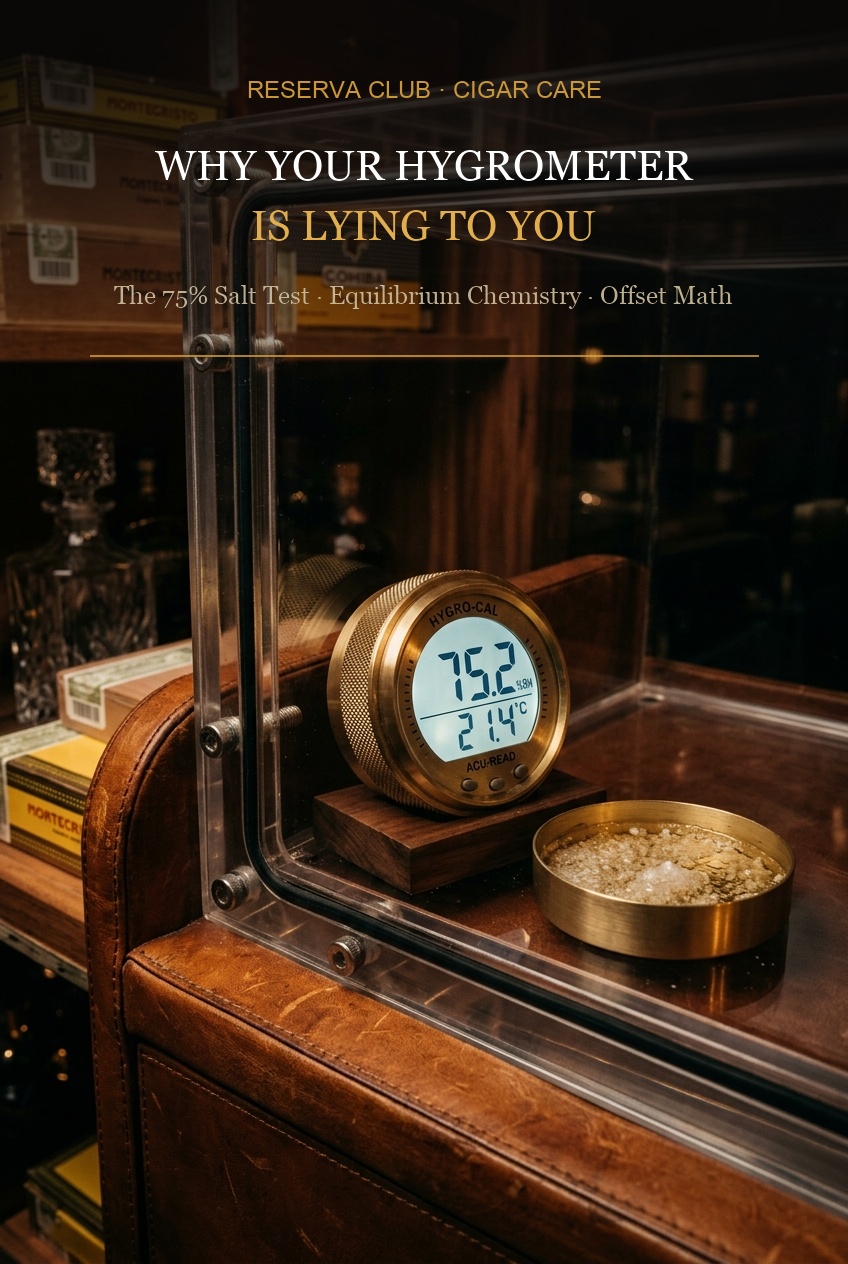
At a standard ambient temperature of 68°F to 70°F (20°C to 21.1°C), the vapor pressure exerted by a saturated sodium chloride slurry produces an exact 75.3% Relative Humidity inside a sealed, airtight container.
| Ambient Temperature | Equilibrium Relative Humidity (NaCl Slurry) |
|---|---|
| 60°F (15.5°C) | 75.6% RH |
| 65°F (18.3°C) | 75.4% RH |
| 70°F (21.1°C) | 75.3% RH (Target Standard) |
| 75°F (23.9°C) | 75.1% RH |
| 80°F (26.7°C) | 74.9% RH |
As illustrated by the data, temperature shifts of a few degrees only alter equilibrium by a fraction of a percent. For all practical humidor management purposes, the benchmark is 75% RH.
Step-by-Step: The 24-Hour Salt Calibration Protocol
To achieve laboratory accuracy, you must follow the correct physical preparation. An improperly mixed salt bath will yield false readings.
Equipment Required:
- Standard non-iodized table salt (kosher or pure culinary NaCl)
- Distilled water (never tap water, which contains mineral contaminants)
- A shallow plastic bottle cap (a standard 20oz soda cap or milk jug cap works best)
- A heavy-duty, airtight freezer bag like Ziploc Heavy-Duty Double-Zipper Freezer Bags or an Airtight Clamp-Gasket Glass Mason Jar
- Your digital hygrometer (such as the budget-friendly ThermoPro TP49 Digital Hygrometer or Caliber IV, with a fresh battery installed)
Step 1: Prepare the Saturated Slurry
Fill your shallow bottle cap roughly three-quarters full with dry salt. Add distilled water a few drops at a time using an eyedropper or spoon handle.
CRITICAL RULE: Do NOT dissolve the salt into water. You are not making saltwater; you are creating a damp crystalline slurry. The mixture should resemble wet beach sand that clumps together without standing water pooling on top. If water floats above the salt, add more salt until it is absorbed.
Step 2: Assemble the Sealed Micro-Chamber
Place the bottle cap on a flat surface inside your airtight glass jar or heavy freezer bag. Carefully place your digital hygrometer next to the cap. Ensure the sensor vents on the hygrometer are facing open air and that no wet salt contacts the instrument casing or electrical contacts.
Step 3: Seal and Insulate
Seal the bag or clamp the jar shut. If using a Ziploc bag, leave a small pillow of air inside so the plastic does not press against the hygrometer buttons or display.
Place the sealed chamber in a temperature-stable room away from direct sunlight, heating vents, drafts, and exterior walls. The optimal ambient environment is 68°F to 70°F.
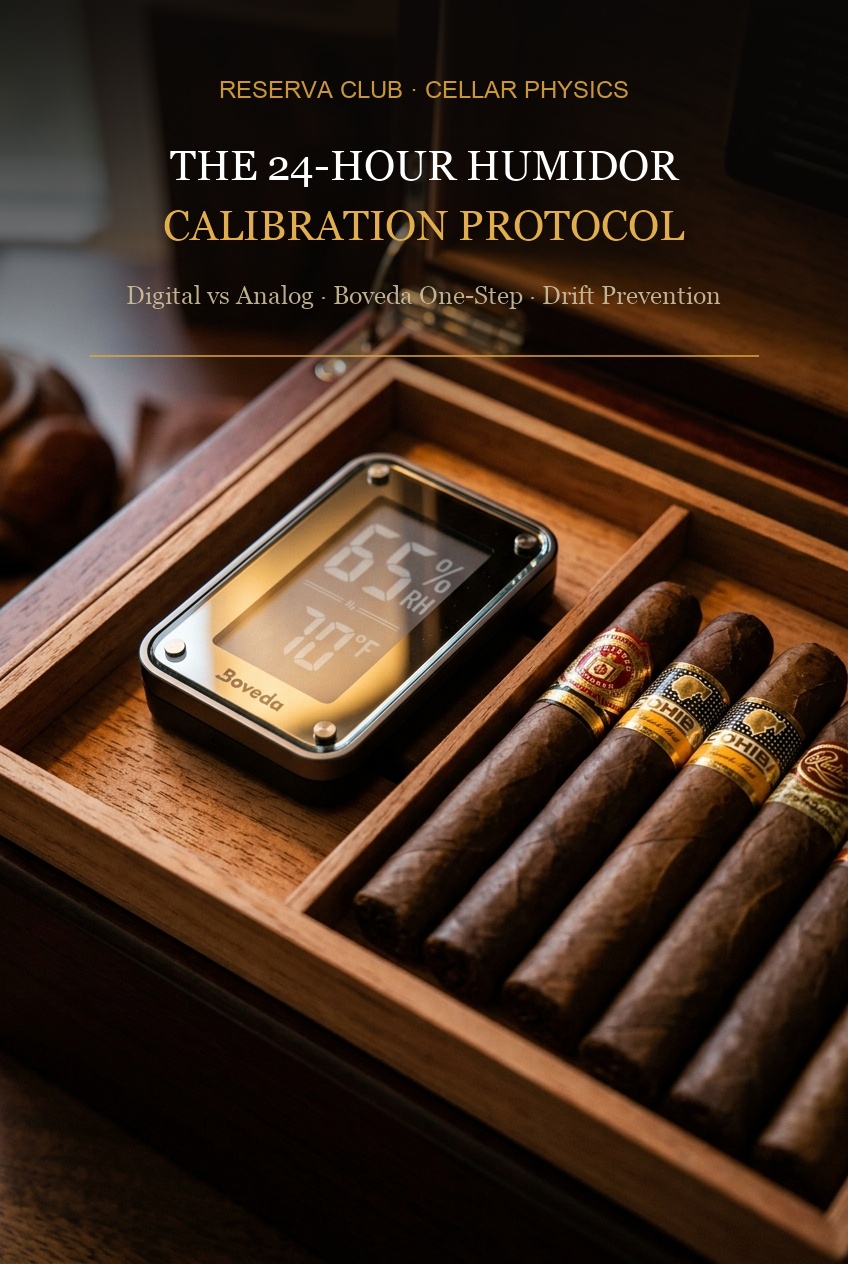
Step 4: The 24-Hour Equilibration Window
Wait a full 24 hours. While the air inside the chamber will approach 70% RH within 3 to 4 hours, reaching true thermodynamic chemical equilibrium between the salt crystals and the vapor space requires a minimum of 18 to 24 hours. Resisting the urge to open the container early is essential.
Step 5: Read and Calculate the Offset
After 24 hours, inspect the reading through the clear glass or plastic without opening the seal:
- Scenario A: Your hygrometer reads exactly 75%. Congratulations—your sensor has zero factory error.
- Scenario B: Your hygrometer reads 71%. Your sensor runs 4% low. Your offset is +4%.
- Scenario C: Your hygrometer reads 79%. Your sensor runs 4% high. Your offset is -4%.
If your device features a digital calibration adjustment dial or toggle button, adjust it immediately to read 75%. If your sensor is non-adjustable, use a label maker or piece of masking tape on the back of the unit noting: Offset: +4% RH. Whenever you view that sensor inside your humidor reading 61%, you know your true humidity is 65%.
The Alternative: Boveda One-Step Calibration Kit
While the salt test costs pennies, it carries two operational failure modes:
- Users accidentally mix a watery solution rather than a crystalline slurry, skewing the equilibrium.
- Knocking over the bottle cap during assembly spills corrosive saltwater directly into the hygrometer's circuit board.
To eliminate human error, Boveda manufactures the Boveda One-Step 75% RH Calibration Kit.
How It Works
The Boveda One-Step Kit consists of a heavy, multi-layer high-barrier vapor pouch containing a specialized 75% Boveda pack. Boveda's patented two-way membrane uses a saturated solution of food-grade salts and purified water enclosed in a vapor-permeable membrane.
Unlike standard polyethylene bags which slowly leak moisture over 24 hours, the Boveda calibration bag features a high-density metallic barrier film that prevents water vapor transmission down to 0.001g/m²/day.
How to Use the Boveda Kit:
- Unzip the high-barrier pouch and insert your digital hygrometer.
- Zip the pouch completely airtight.
- Allow it to rest undisturbed at room temperature for 24 to 32 hours.
- Check the display through the clear pouch window. Calibrate the unit to 75.0%.
The advantage of the Boveda One-Step kit is pure repeatability. Because the membrane prevents liquid spills, you can place multi-sensor smart probes, wireless hygrometers, and delicate electronics inside with zero risk of corrosion.
Digital Sensor Maintenance & Recalibration Cadence
Calibrating a hygrometer is not a one-and-done event. All electronic sensors experience physical drift over time due to:
- Micro-oxidation of internal contacts: Trace airborne oils and cedar resins slowly coat the dielectric polymer layer.
- Battery voltage decay: As button-cell lithium batteries drop below nominal voltage (3.0V), sensor readings often drift upward or become erratic.
- Physical relocation: Moving humidors between air-conditioned summer rooms and furnace-heated winter basements stresses sensor solder joints.
The Connoisseur Maintenance Schedule:
- Semi-Annual Recalibration: Recalibrate all humidor sensors twice a year (typically in Spring and Autumn during seasonal HVAC transitions).
- Mandatory Post-Battery Recalibration: Whenever you replace a CR2032 or AAA battery, perform a 24-hour calibration check before returning the unit to your cedar trays.
- Cross-Sensor Sanity Checks: If you run multiple humidors, swap hygrometers between cabinets every quarter. If one cabinet suddenly reads 5% different with the swapped unit, you have detected sensor drift.
Setting Your Humidor Target: Beyond the 70/70 Myth
Once your hygrometers are calibrated to laboratory accuracy, what Relative Humidity should you target inside your humidor?
For decades, commercial retailers pushed the 70/70 Rule: 70°F temperature and 70% Relative Humidity. In modern cigar collecting, the 70/70 rule is widely regarded as outdated and hazardous:
- 70% RH at 70°F+ creates prime conditions for tobacco beetles: Lasioderma serricorne larvae remain dormant at 65°F but hatch vigorously above 72°F in humid conditions.
- Modern New World wrappers (Nicaraguan Habano, Mexican San Andrés, Connecticut Broadleaf) are oily and thick: At 70% RH, dense leaves hold excessive moisture, causing uneven burns, canoeing, frequent relights, and bitter tunneling.
The Optimal Connoisseur Benchmarks:
- New World Full-Bodied Cigars: 65% RH at 65°F–68°F maintained with Boveda 65% RH 2-Way Humidity Control Packs. (Produces razor-sharp burns, clean white ash, and vibrant flavor separation).
- Cuban Cigars (Habanos): 62%–64% RH at 64°F–66°F. (Cuban rolling leaf is packed tightly; lower moisture prevents tight draws and sour, plugged vitolas).
- Aging Cabinets / Long-Term Cellaring (5+ Years): 65%–67% RH with absolute thermal stability.
Recommended Connoisseur Gear & Calibration Hardware
To achieve laboratory precision in your humidor, here is the exact equipment recommended by Reserva Club:
- Primary Digital Hygrometer: Western Humidor Caliber IV Digital Hygrometer — The industry benchmark for ±1% RH capacitive accuracy with manual calibration adjustment.
- Smart Wireless Sensor: SensorPush Wireless Bluetooth Thermometer & Hygrometer — Monitor humidity and temperature curves from your phone with 1-minute historical data logging.
- Budget-Friendly Sensor: ThermoPro TP49 Digital Mini Hygrometer — Compact, high-accuracy digital sensor ideal for tight desktop cedar trays.
- Calibration Benchmark: Boveda One-Step 75% RH Calibration Kit — High-barrier vapor pouch delivering guaranteed 75.0% calibration without salt spill risks.
- Humidor Seasoning Standard: Boveda 84% RH Humidor Seasoning Packs (4-Pack) — Saturated two-way vapor packs for 14-day passive cedar conditioning.
- Cellar Humidity Maintenance: Boveda 65% RH 2-Way Humidity Control Packs — The optimal relative humidity benchmark for oily New World vitolas.
- Airtight Micro-Chamber: Sistema 7-Liter Airtight Food Storage Container — Flexible silicone-gasket snap container for sensor calibration and temporary tupperdor storage.
Frequently Asked Questions
Can I calibrate an analog hygrometer using the salt test?
Yes. Follow the exact same 24-hour salt test protocol inside a sealed glass Mason jar. Once the 24 hours have elapsed, quickly remove the analog hygrometer and use a small flathead screwdriver to turn the calibration screw on the back until the needle aligns with 75%. Note that you must complete this adjustment within 30 seconds of opening the jar, as analog bi-metal springs react rapidly to ambient room humidity.
Why is my hygrometer reading 79% during the salt test?
If your hygrometer reads 79% after 24 hours in a properly sealed chamber, your sensor is overreporting relative humidity by 4%. If your unit cannot be manually adjusted, subtract 4% from every future reading inside your humidor (e.g., if it reads 69%, your cigars are actually at 65%).
How long does a calibrated hygrometer stay accurate?
High-quality capacitive sensors typically maintain calibration accuracy for 6 to 12 months. Cheaper resistive sensors can drift within 90 days. We recommend running a 24-hour verification flight every six months.
Does the temperature of the room change the salt test result?
Only negligibly between 60°F and 80°F. The chemical equilibrium of saturated sodium chloride changes by less than 0.7% RH across that entire 20-degree span. As long as your testing room stays near normal room temperature (68°F–72°F), 75% RH is your target.
Log Your Cellar Metrics with Reserva Club
Keeping your collection in pristine smoking condition requires tracking more than just a single number on a dial. With Reserva Club, you can log your humidor humidity curves, inventory rare vitolas, record detailed cigar tasting sessions, and pair aged leaves with allocated bourbons in your private collector vault.
More from The Codex
The Private Syndicate Playbook: How Collectors Pool Allocations, Split Barrels, and Share Vaults
Read Guide →The Master Guide to Infinity Bottles: Solera Math, Proof Calculations, and Blending Chemistry
Read Guide →Proof Equilibrium: The Sommelier Science of Pairing High-Proof Whiskey and Fine Cigars
Read Guide →The Silo Problem: Why the Modern Connoisseur Outgrows Single-Category Apps
Read Guide →I've Owned 11 Humidors. Here's What I Actually Recommend.
Read Guide →The Right Way to Season a Humidor (I Learned This the Hard Way)
Read Guide →
Smoke · Sip · Savor
Ready to track your cigars, aging dates, and humidor collection?
Start My Digital Humidor →Reserva Club is reader-supported. When you purchase through links on our site, we may earn an affiliate commission at no extra cost to you. As an Amazon Associate, we earn from qualifying purchases.