

Tobacco Beetles (Lasioderma serricorne): Identification, Freezing Protocol, and Cellar Quarantine
The nightmare of every cigar collector. How to identify dormant beetle larvae, temperature triggers (the 72°F rule), and the scientific 3-stage sub-zero freezing protocol to save your cellar.
Table of Contents
- The Biology of the Beast: Lasioderma Serricorne
- The 72°F Danger Zone: Environmental Triggers
- Diagnostic Check: Beetles vs. Mold vs. Plume
- The Science of Sub-Zero Eradication
- The Step-by-Step 3-Stage Freezing Protocol
- Humidor Sterilization and Cellar Quarantine
- Recommended Cellar Defense & Quarantine Hardware
- Frequently Asked Questions
- Protect Your Vault with Reserva Club

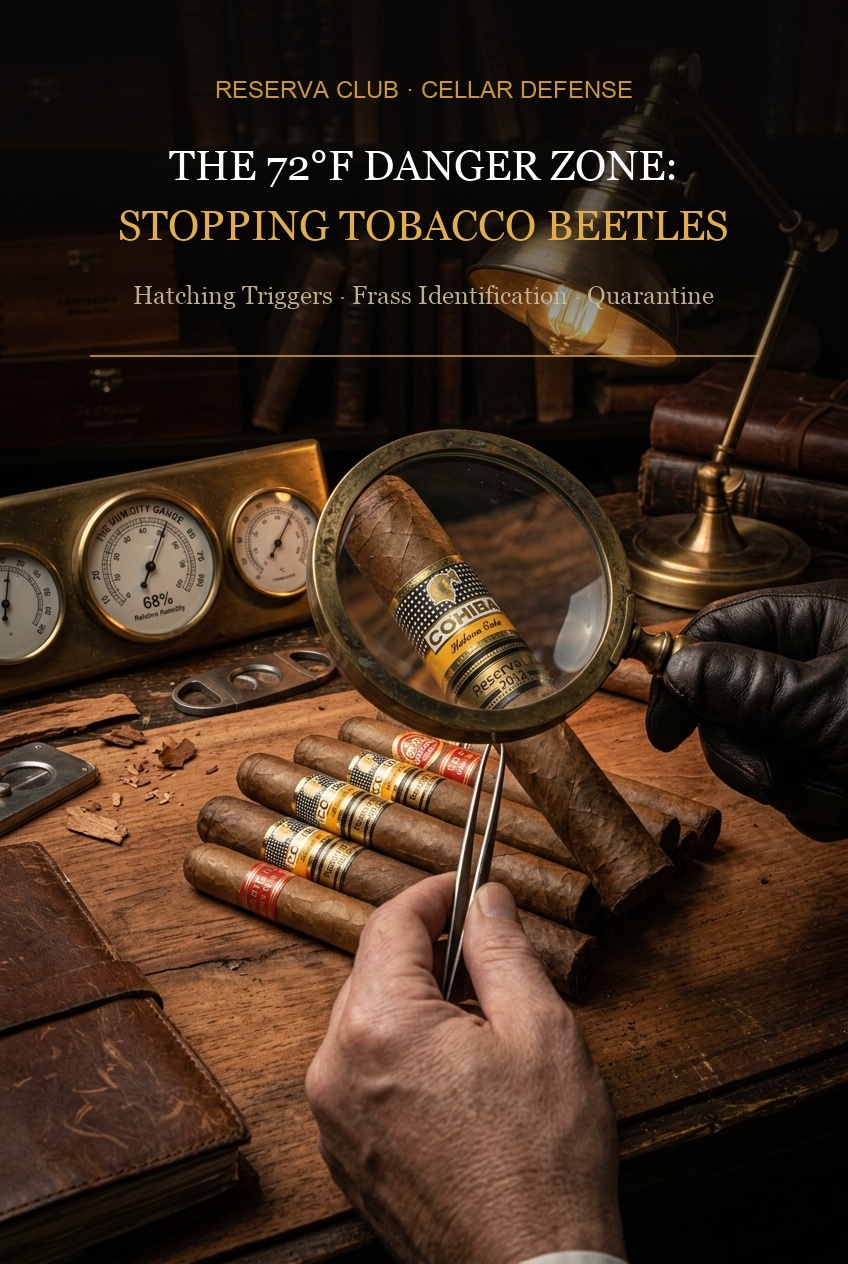
Every serious cigar collector remembers the sinking pit in their stomach the first time they pull an aged, allocated vitola from their humidor and discover a clean, razor-sharp, circular pinhole bored straight through the wrapper.
Tap the foot of the cigar gently against a clean white sheet of paper, and a tiny shower of fine brown powder spills out.
You have encountered Lasioderma serricorne—the notorious tobacco beetle.
A single fertile female beetle can lay over 100 microscopic eggs in the folds of cured tobacco. Unchecked, a small outbreak can chew through thousands of dollars of vintage Cubans, OpusX, and rare boutique cigars in less than three weeks, reducing prized leaves to swiss cheese and dust.
However, a beetle infestation does not mean you must incinerate your humidor or discard your entire collection.
In this master guide, we examine the biological lifecycle of Lasioderma serricorne, reveal the thermal triggers that wake dormant eggs, and provide the exact 3-Stage Sub-Zero Freezing Protocol to eradicate beetles at all developmental stages without damaging delicate wrapper leaves.
The Biology of the Beast: Lasioderma Serricorne
To eradicate tobacco beetles, you must understand their biology.
The tobacco beetle is a tiny, reddish-brown, oval insect measuring approximately 2mm to 3mm in length. While adult beetles have wings and can fly short distances, adult beetles do not eat tobacco. The adults live for only two to four weeks, driven by a single biological imperative: mating and laying eggs.
The True Culprit: The Voracious Larva
The microscopic eggs (laid on the tobacco leaf during field curing or factory rolling) hatch into tiny white, grub-like larvae covered in fine bristles.
The larval stage lasts between 5 and 10 weeks:
- The larva eats continuously, tunneling through the filler, binder, and wrapper leaves.
- As it consumes the tobacco, it excretes a fine, granular powder known as frass (beetle droppings).
- Once mature, the larva forms a pupal cocoon inside the cigar. When it emerges as an adult, it bores a flawless, circular exit hole (1mm to 2mm in diameter) straight through the outer wrapper leaf to take flight.
[ Microscopic Eggs ] ──(Trigger: >72°F & >70% RH)──► [ Voracious Larvae ]
                                                              │
                                                     Tunnels & Eats Leaf
                                                     Produces Frass Dust
                                                              │
                                                              ▼
[ Adult Beetles Bore Exit Holes ] ◄── [ Pupal Cocoon Stage ]
The 72°F Danger Zone: Environmental Triggers
Nearly all premium handmade cigars—even those from elite factories—carry microscopic, dormant beetle eggs within their leaves. Factories attempt to freeze leaves before export, but eggs are remarkably resilient.
In a properly maintained humidor, those eggs remain completely harmless and dormant indefinitely.
They only hatch when you breach the 72/70 Danger Zone:
- The Critical Temperature Threshold: Beetle eggs remain dormant below 68°F (20°C). When ambient temperature rises above 72°F (22.2°C), metabolic activity triggers hatching.
- The Moisture Multiplier: If high temperature is accompanied by relative humidity above 70% RH, hatching accelerates drastically. Eggs can hatch into hungry larvae in as little as 6 to 8 days.
This is why beetle outbreaks peak during July and August when residential air conditioning fails, or when humidors are placed in direct sunlight or near home heat registers.
Diagnostic Check: Beetles vs. Mold vs. Plume
Before initiating emergency protocols, confirm whether you are dealing with beetles:
| Diagnostic Feature | Active Beetle Infestation | Harmless Foot Damage | White Mold Outbreak |
|---|---|---|---|
| Visual Evidence | Perfect 1mm–2mm circular holes | Irregular cracks or splits | Fuzzy white or green spores |
| Powder Residue | Fine brown dust (frass) from foot | Dry leaf flakes | Sticky fungal threads |
| Location | Anywhere on wrapper or foot | Along veins or cap | Leaf surface only |
| Spread Rate | Spreads rapidly between adjacent sticks | Isolated to damaged stick | Spreads via airborne spores |
The Tap Test: Hold the suspected cigar vertically over a white piece of printer paper and tap the foot firmly with your knuckle three times. If fine brown sand or dust cascades onto the paper, you have active beetle tunneling inside the core.
The Science of Sub-Zero Eradication
Can you smoke a cigar with a beetle hole? If the hole is isolated and no larvae remain, you can cover the hole with your finger to maintain draw pressure and smoke it. But every cigar sharing that humidor is now compromised.
Chemical insecticides are completely forbidden—they will permanently ruin your Spanish cedar and poison your cigars.
The only safe, scientific solution is thermal shock through deep freezing.
According to entomological research from the USDA and tobacco agricultural institutes, complete mortality of Lasioderma serricorne across all four life stages (adults, pupae, larvae, and eggs) occurs when core temperatures reach:
- 0°F (-18°C) for 72 continuous hours, or
- -4°F (-20°C) for 48 continuous hours.
The Thermal Shock Trap (Why You Cannot Just Toss Them in the Freezer)
Water expands by roughly 9% when it freezes into ice crystals. If you throw a warm, humidified cigar directly into a sub-zero domestic freezer, the moisture inside the filler leaf freezes instantly into jagged ice needles, expanding and violently rupturing the wrapper along its delicate seams. Furthermore, when you take a frozen cigar straight into warm room air, condensation will form across the wrapper, turning it into soggy mush.
To protect your vitolas, you must follow the 3-Stage Step-Down and Step-Up Protocol.
The Step-by-Step 3-Stage Freezing Protocol
Preparation & Packaging
- Quarantine Inspection: Remove every single cigar from your humidor. Inspect each one closely using an illuminated 40X All-Metal Jeweler's Magnifying Loupe with LED. Cigars with multiple bored holes and extensive tunneling should be photographed for insurance/records and discarded.
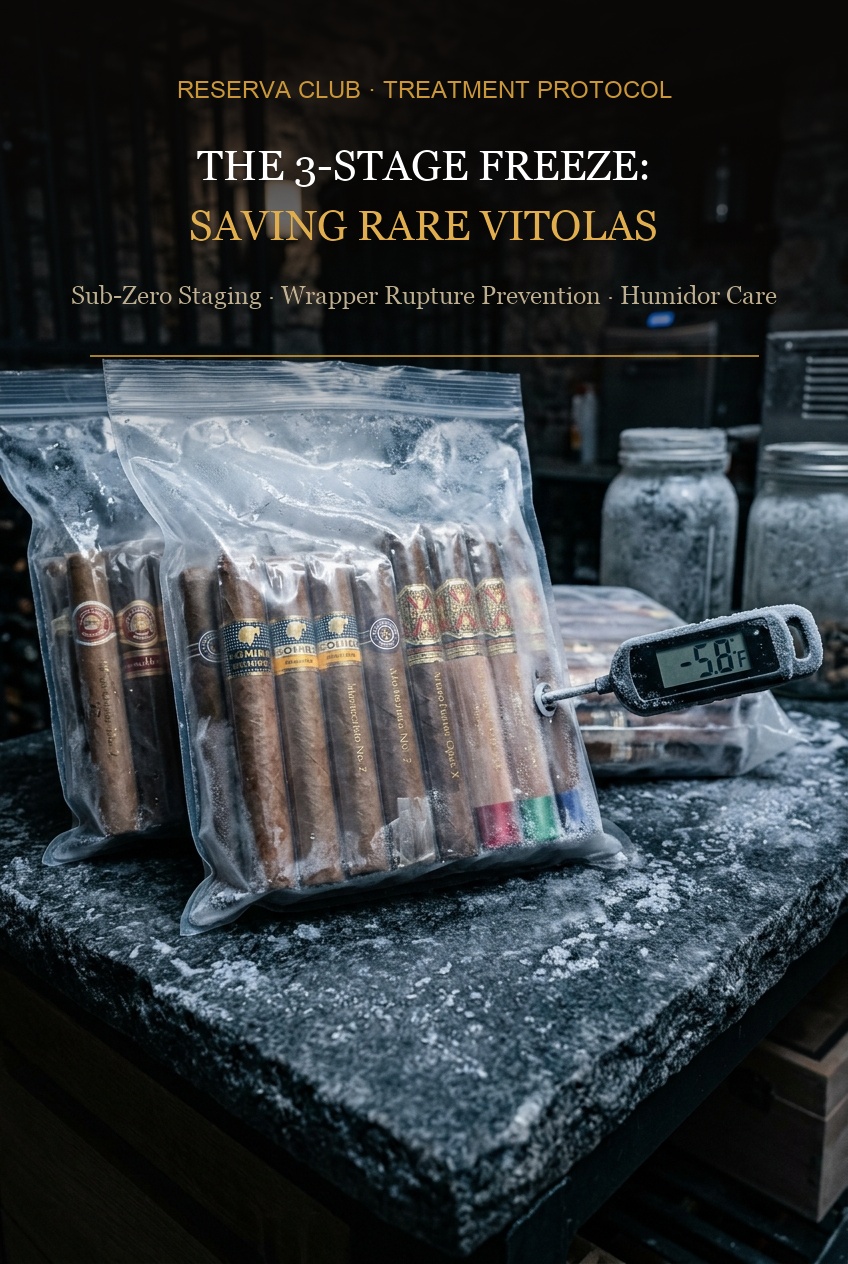
- Double Bagging in Heavy Freezer Bags: Place unblemished cigars in groups of 5 to 10 inside heavy-duty, Ziploc Heavy-Duty Double-Zipper Gallon Freezer Bags.
- Purge Excess Air: Slowly roll the bag toward the zipper to squeeze out all ambient air before sealing. Place that sealed bag inside a second freezer bag, zipping it in the opposite direction. The double-barrier prevents humidity loss in the dry freezer environment and stops food odors from permeating the tobacco.
Stage 1: The Refrigerator Step-Down (40°F / 4°C)
- Duration: 24 to 36 Hours
- Place the double-bagged cigars on a middle shelf of your standard refrigerator.
- The Goal: This gradually cools the tobacco, lowering the temperature of the internal moisture without creating ice crystals. It conditions the cellular walls of the wrapper to withstand sub-zero temperatures.
Stage 2: The Deep Freeze (-4°F to 0°F / -20°C to -18°C)
- Duration: Full 72 Hours (3 Days)
- Move the bags from the refrigerator into the deepest, coldest section of your freezer (ideally against the back wall, far from the door).
- The Goal: Sub-zero temperatures freeze the eggs and larvae, causing complete cellular lysis and 100% biological mortality. Set your freezer to its coldest setting for this window.
Stage 3: The Refrigerator Step-Up (40°F / 4°C)
- Duration: 24 to 36 Hours
- Move the bags back into the refrigerator.
- The Goal: This slow thawing phase allows the ice crystals to gently melt back into liquid water, which is reabsorbed into the tobacco cellular matrix.
Stage 4: Room Temperature Acclimation
- Duration: 24 Hours (Still Sealed)
- Remove the bags from the refrigerator and place them on a countertop at room temperature.
- CRITICAL RULE: Do NOT open the bags. Allow the packages to reach room temperature while still sealed. Any moisture that condenses from ambient room air will form on the outside of the plastic bag—not on your cigar wrappers.
Humidor Sterilization and Cellar Quarantine
While your cigars are in the freezer, you must sterilize the infected humidor. Beetle larvae frequently crawl out of cigars to pupate in the dark corners and crevices of Spanish cedar lining.
Step 1: Deep Vacuuming
Use a vacuum cleaner with a clean soft-brush attachment to thoroughly vacuum all cedar trays, dividers, and interior corners to remove frass, egg dust, and dead insects.
Step 2: Cedar Sterilization with Isopropyl Alcohol
Never wash Spanish cedar with water, bleach, or kitchen disinfectants—water will warp precision tongue-and-groove joints, and chemicals will permanently ruin the wood's aroma.
- Lightly dampen a clean microfiber cloth with 99% pure isopropyl alcohol (or 151+ proof grain alcohol like Everclear).
- Gently wipe down all interior cedar surfaces, focusing on joints and hinges. High-proof alcohol evaporates almost instantly, leaving zero water residue while killing any exposed microscopic larvae and fungal spores.
Step 3: Aeration and Re-Seasoning
- Leave the humidor open in a clean, shaded room for 48 hours to allow all alcohol vapors to dissipate completely.
- Place fresh Boveda 84% Seasoning Packs (4-Pack) inside for 14 days to re-saturate the kiln-dried cedar with clean moisture.
Step 4: The 60-Day Quarantine Tupperdor
Once your cigars are thawed and your main humidor is re-seasoned, do not immediately mix the thawed sticks back into your master collection.
Place them in an airtight container like the Sistema 7-Liter Airtight Food Storage Container lined with Spanish Cedar Humidor Trays with Adjustable Dividers equipped with Boveda 65% 60g 2-Way Humidity Packs and a calibrated digital hygrometer. Monitor them for 60 days at 65°F–68°F. If no new holes or frass appear after two months, your collection is officially clean and safe to return to your primary humidor.
Recommended Cellar Defense & Quarantine Hardware
When protecting valuable allocated cigars from beetle infestations and temperature spikes, rely on these professional tools:
- Freezer Storage Standard: Ziploc Heavy-Duty Gallon Freezer Storage Bags — Multi-layer moisture barrier prevents freezer burn and protects essential wrapper oils during sub-zero cycles.
- Digital Cellar Thermometer: ThermoPro Waterproof Digital Instant-Read Temperature Probe — Verify exact core sub-zero temperatures inside your deep freeze step-down chamber.
- Airtight Quarantine Tupperdor: Sistema 7-Liter Airtight Food Storage Container — Heavy-duty rubber clamp-seal container creates a zero-leak 60-day isolation environment.
- Spanish Cedar Storage Trays: Spanish Cedar Humidor Trays with Adjustable Dividers — Real kiln-dried Spanish cedar trays to organize quarantined vitolas while maintaining airflow.
- Inspection Loupe with LED: 40X All-Metal Jeweler's Magnifying Loupe with LED Light — Inspect cigar feet, wrapper seams, and tobacco folds for microscopic frass dust and exit pinholes.
- Sanitizing Re-Seasoning Packs: Boveda 84% RH Humidor Seasoning Packs (4-Pack) — Recondition your sterilized Spanish cedar humidor after alcohol wipe-down.
- Long-Term Storage Packs: Boveda 65% 60g 2-Way Humidity Control Packs — Stable 65% RH baseline prevents beetle egg reactivation while curing fine tobacco.
Frequently Asked Questions
Can I smoke a cigar that had a tobacco beetle in it?
Yes, provided the damage is minor. If there is only one exit hole and the cigar retains good structural firmness, you can place a piece of cigar band or your fingertip over the hole to maintain airtight draw suction. While the thought of larvae frass inside the filler leaf is unappealing, dried frass is simply powdered tobacco and poses no health hazard once combusted. However, heavily tunneled cigars with sponge-like texture should be discarded.
Does freezing cigars ruin their flavor or aging potential?
No. In fact, nearly all major cigar manufacturers in Nicaragua, the Dominican Republic, and Honduras freeze their exported boxes in industrial cooling chambers before shipping to international distributors. When executed with the proper 3-stage step-down and step-up protocol, the delicate essential oils and volatile flavor compounds remain completely uncompromised.
Will high humidity alone trigger beetle eggs to hatch?
No. Temperature is the primary biological trigger. You can hold cigars at 75% RH, and as long as the temperature remains below 65°F (18.3°C), beetle eggs will remain dormant. However, once temperature breaches 72°F, high humidity acts as an accelerator.
Protect Your Vault with Reserva Club
Keeping rare cigars safe from environmental hazards requires continuous vigilance. With Reserva Club, you can monitor cellar temperatures, track aging milestones for individual vitolas, and log humidor health across your private collection.
More from The Codex
The Connecticut Shade Morning Ritual: Pairing Mild Cigars with Espresso & Wheated Bourbon
Read Guide →Wheated vs. High-Rye Bourbon: Decoding Mashbills, Palate Weight, and Finish
Read Guide →How to Calibrate a Digital Hygrometer: The 75% Salt Test vs. Boveda One-Step
Read Guide →The Private Syndicate Playbook: How Collectors Pool Allocations, Split Barrels, and Share Vaults
Read Guide →The Master Guide to Infinity Bottles: Solera Math, Proof Calculations, and Blending Chemistry
Read Guide →Proof Equilibrium: The Sommelier Science of Pairing High-Proof Whiskey and Fine Cigars
Read Guide →
Smoke · Sip · Savor
Ready to track your cigars, aging dates, and humidor collection?
Start My Digital Humidor →Reserva Club is reader-supported. When you purchase through links on our site, we may earn an affiliate commission at no extra cost to you. As an Amazon Associate, we earn from qualifying purchases.