Wheated vs. High-Rye Bourbon: Decoding Mashbills, Palate Weight, and Finish
Understanding secondary grains in Kentucky straight bourbon. How wheat soft polysaccharides contrast rye peppery 4-vinylguaiacol, proof dynamics, and cigar pairing strategies.
Table of Contents
- The Chemical Baseline: What Corn and Barley Deliver
- The Wheated Mashbill: Soft Polysaccharides and Gentle Aging
- The High-Rye Mashbill: 4-Vinylguaiacol, Phenols, and Fiery Bite
- Mashbill Architecture: Side-by-Side Comparison
- Proof Dynamics: How Alcohol Volume Alters Grain Expression
- Pairing Philosophy: Matching Mashbills with Fine Cigars
- How to Host a Comparative Mashbill Flight
- Recommended Tasting Glassware & Connoisseur Barware
- Frequently Asked Questions
- Build Your Private Whiskey Vault with Reserva Club
In American whiskey, two bottles of Kentucky Straight Bourbon aged for the exact same eight years in identical charred white oak barrel (or test rapid wood extraction at home with Charred American White Oak Aging Staves)s can taste like entirely different spirits. One delivers velvety notes of vanilla custard, ripe red berries, and honeycomb; the other explodes with cracked peppercorns, mint, clove, and leathery oak.
The secret to this dramatic sensory divergence lies not in the oak, nor in the water source, but in the flavoring grain of the mashbill.
By federal law, bourbon must contain at least 51% yellow dent corn, with malted barley generally contributing 5% to 12% to provide the alpha- and beta-amylase enzymes needed to convert complex grain starches into fermentable sugars. That leaves the remaining 10% to 35% of the grain recipe—the secondary "flavor grain"—to define the spirit's structural personality.
Distillers face a pivotal fork in the road: soft red winter wheat or spicy grain rye.
In this master guide, we decode the chemistry of wheated versus high-rye mashbills, examine the extraction curves of secondary grains in charred barrels, and explore how each style interacts with the palate and fine cigars.
The Chemical Baseline: What Corn and Barley Deliver
To understand the impact of wheat and rye, you must first isolate the core canvas of straight bourbon:
- Corn (51%–80%): Yellow dent corn is high in simple starches. During fermentation and double distillation, corn yields sweet, round, oily new-make spirit dominated by fructose and glucose precursors. In the barrel, corn spirit develops foundational notes of buttered popcorn, sweet cream, toasted cornflake, and brown sugar.
- Malted Barley (5%–12%): Malted barley is primarily a functional enzymatic engine, but it imparts subtle biscuity, toasted cereal, and malty undertones to the distillate.
With corn providing the sweet body and barley providing enzymatic conversion, the secondary grain acts as the sonic amplifier that shapes the attack, mid-palate density, and finish of the pour.
The Wheated Mashbill: Soft Polysaccharides and Gentle Aging
When a distiller replaces rye with wheat, they almost universally choose soft red winter wheat.
The historical benchmark for wheated bourbon traces back to Julian "Pappy" Van Winkle Sr. and Alex Farnsley at the legendary Stitzel-Weller Distillery in Shively, Kentucky. When William Larue Weller pioneered substituting wheat for rye in 1849, his goal was to create a bourbon that was "gentle on the tongue" without the bite of spicy rye.
The Chemistry of Wheat
Soft red winter wheat contains significantly less protein and gluten than hard spring wheat, boasting high concentrations of water-soluble polysaccharides. Wheat lacks the pungent essential oils and volatile phenolic precursors found in rye.
As a result:
- The New-Make Spirit: Distillate emerging from the doubler is remarkably clean, sweet, and doughy, reminiscent of sourdough starter, sweet flour, and honeysuckle.
- Palate Weight: Wheated bourbon exhibits a round, viscous, coating mouthfeel. The entry is broad, enveloping the entire tongue simultaneously with a velvety, dessert-like texture.
- Primary Tasting Notes: Caramel, vanilla bean, butterscotch, baked brioche, dried red cherries, marzipan, and confectioner's sugar.
The Barrel Extraction Dynamics of Wheat
Because wheat lacks aggressive botanical spices, the spirit interacts with the charred white oak barrel with delicate balance. The spirit extracts wood sugars (vanillin, furfural, and oak lactones) without clashing against harsh grain tannins.
This unique biochemical neutrality explains why wheated bourbons can age for 12, 15, 20, or even 23 years (such as Pappy Van Winkle Family Reserve or Weller C.Y.P.B.) without tasting like an over-extracted board of bitter lumber. In long-term aging, wheat preserves fruit esters and honeyed sweetness while the wood slowly deepens into polished leather.
Iconic Wheated Bourbons:
- W.L. Weller (Special Reserve, 12 Year, Antique 107, Full Proof, Single Barrel)
- Pappy Van Winkle / Old Rip Van Winkle
- Maker's Mark (and Cask Strength / Wood Finishing Series)
- Larceny & Old Fitzgerald (Heaven Hill Wheated Collection)
- Wilderness Trail Yellow Label
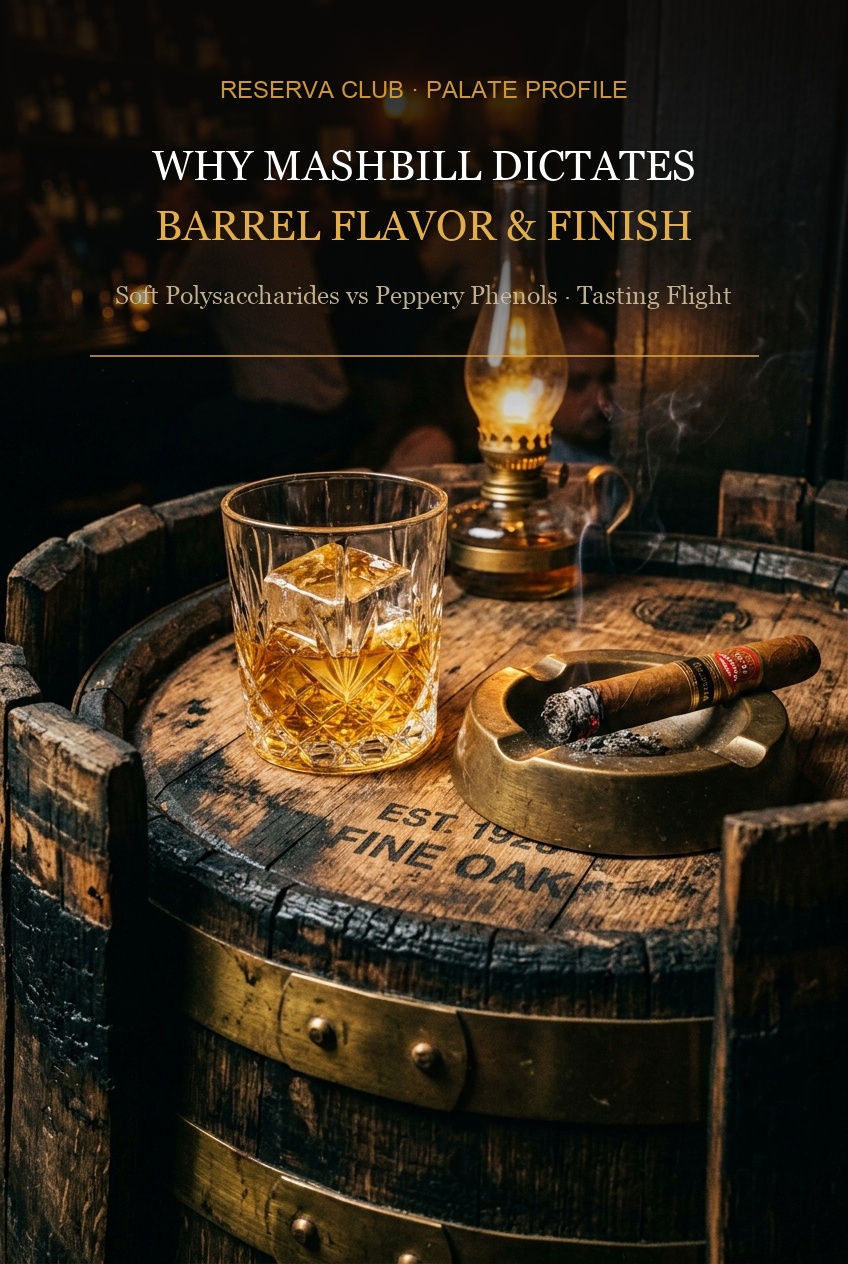
The High-Rye Mashbill: 4-Vinylguaiacol, Phenols, and Fiery Bite
At the opposite end of the sensory spectrum sits the High-Rye Mashbill. While traditional bourbons use 10% to 15% rye, high-rye bourbons push the rye content to 20%, 25%, or even 35% (approaching the legal 51% threshold where bourbon becomes a Rye Whiskey).
The Chemistry of Rye (Secale cereale)
Rye is a botanical powerhouse packed with ferulic acid, alkylresorcinols, and terpene precursors. During fermentation by Saccharomyces yeast strains, ferulic acid decarboxylates into 4-vinylguaiacol—a powerful organic chemical compound responsible for spicy, clove-like, and medicinal aromas.
Rye grain also contains high levels of lignin-derived aromatic aldehydes.
When high-rye spirit enters the barrel:
- The Palate Attack: High-rye bourbon does not coat the tongue passively—it strikes the center and back of the palate with an energetic, tingling, peppery punch.
- Structure and Acidity: Rye imparts a leaner, drier mouthfeel with a refreshing citrus brightness that prevents the corn sweetness from becoming cloying.
- Primary Tasting Notes: Cracked black pepper, spearmint, wintergreen, ground cinnamon, nutmeg, candied orange peel, rye bread, dark cocoa, and dried tobacco leaf.
The Aging Paradox of High-Rye Bourbon
Rye's intense chemical signature creates exceptional complexity at younger ages (4 to 8 years). The fiery spice balances fresh char and toasted wood sugars effortlessly. However, because both rye grain and charred oak are rich in bitter tannins, aging a high-rye bourbon beyond 12 to 14 years requires meticulous barrel management. Without climate-controlled warehouses, high-rye whiskey can become unpleasantly dry and astringent as the wood tannins overwhelm the delicate baking spices.
Iconic High-Rye Bourbons:
- Four Roses (Recipes featuring the "B" mashbill: 35% rye, such as Single Barrel OBSV and OBSK)
- Bulleit Bourbon (28% rye mashbill produced at contract facilities)
- Wild Turkey 101 & Rare Breed (13%–18% bold rye profile)
- Woodford Reserve (18% rye)
- Old Grand-Dad & Basil Hayden (Jim Beam high-rye mashbill, ~27% rye)
Mashbill Architecture: Side-by-Side Comparison
| Metric | Traditional Bourbon | Wheated Bourbon | High-Rye Bourbon |
|---|---|---|---|
| Typical Corn % | 72% – 78% | 68% – 75% | 60% – 68% |
| Secondary Grain | Rye (10% – 15%) | Wheat (16% – 20%) | Rye (20% – 36%) |
| Malted Barley % | 10% – 12% | 10% – 12% | 10% – 12% |
| Palate Texture | Balanced, medium body | Creamy, viscous, velvety | Lean, vibrant, tingling |
| Flavor Profile | Caramel, vanilla, light pepper | Brioche, honey, red fruits, toffee | Black pepper, mint, citrus, clove |
| Optimal Oak Age | 6 to 12 Years | 8 to 20+ Years | 5 to 10 Years |
| Leading Examples | Buffalo Trace, Elijah Craig | Weller 12, Maker's Mark 46 | Four Roses Single Barrel, Bulleit |
Proof Dynamics: How Alcohol Volume Alters Grain Expression
The mashbill provides the genetic blueprint, but Bottled Proof (Alcohol by Volume, ABV) determines how those grain compounds vaporize on your tongue:
Low Proof (80 to 92 Proof / 40%–46% ABV)
At lower proof points, added water breaks down ethanol chains, making sweetness and soft wood lactones dominant. Wheated bourbons shine at 90 proof as smooth, dessert-forward daily sippers. However, high-rye bourbons watered down to 80 proof can taste thin, as the diluting water mutes rye's essential spice oils.
Cask Strength / Barrel Proof (105 to 125+ Proof / 52.5%–62.5%+ ABV)
At uncut barrel proof, high-proof ethanol vapor carries aromatic terpenes rapidly to your olfactory receptors:
- Barrel Proof Wheated (e.g., Weller Full Proof, Maker's Cask Strength): Delivers intense dark toffee, molten butterscotch, and deep cherry cordial without sharp tongue bite.
- Barrel Proof High-Rye (e.g., Four Roses Small Batch Select, Rare Breed): An exhilarating, explosive tasting experience. Clove, cinnamon red hots, and peppermint burst across the palate with long, drying, spicy finishes.
Pairing Philosophy: Matching Mashbills with Fine Cigars
A seasoned connoisseur never pairs cigars and whiskey at random. The secret to an extraordinary pairing is understanding whether you are seeking Flavor Harmony (mirroring notes) or Palate Contrast (cutting through richness).
1. Pairing with Wheated Bourbons (The Harmonious Approach)
Wheated bourbons excel alongside mild-to-medium cigars that share its creamy, pastry-like lipid profile:
- Connecticut Shade: The almond, cedar, and cream notes of an Ecuadorian Connecticut wrapper mesh seamlessly with the honey and vanilla of a 90-proof wheated pour. Neither element overpowers the other.
- Aged Cuban Vitolas: Delicate vintage Habanos (such as Hoyo de Monterrey Epicure No. 2) possess subtle floral and cedar notes that would be crushed by high-rye spice, but thrive alongside the soft red winter wheat of Weller 12.
2. Pairing with High-Rye Bourbons (The Dynamic Contrast Approach)
High-rye bourbons possess the spice, acidity, and tannic backbone required to stand up to heavy, oily, full-bodied cigars:
- Mexican San Andrés Maduro: The thick, toothy, fermented wrapper (best prepared with a razor-sharp Colibri V-Cut Premium Cigar Cutter and toasted with a Xikar Tactical Triple Torch Jet Lighter) of a maduro cigar yields notes of dark unsweetened chocolate, damp earth, and espresso. A high-rye bourbon cuts right through those dense cocoa oils with mint, cracked pepper, and citrus zest, cleansing the palate between draws.
- Nicaraguan Habano: Habano leaves grown in volcanic Jalapa or Estelí soil share rye's natural 4-vinylguaiacol peppery profile. Pairing a Four Roses Single Barrel with a Nicaraguan Habano creates a resonant spice crescendo.
🎖️ Curated Flight Recommendation:
- The Comparative Wrapper Flight: To taste the structural difference between Connecticut Shade, Nicaraguan Habano, Corojo, and Broadleaf Maduro side-by-side with your whiskey flights, Famous Smoke Shop is offering the 20-Cigar Wrapper Showcase Sampler at 57% Off ($80.95).
- Build Your Custom Flight: If you prefer assembling a tailor-made pairing rotation, the Famous Cigars 5-Pack Fantasy Draft lets you save up to 20% on custom 5-packs.
How to Host a Comparative Mashbill Flight
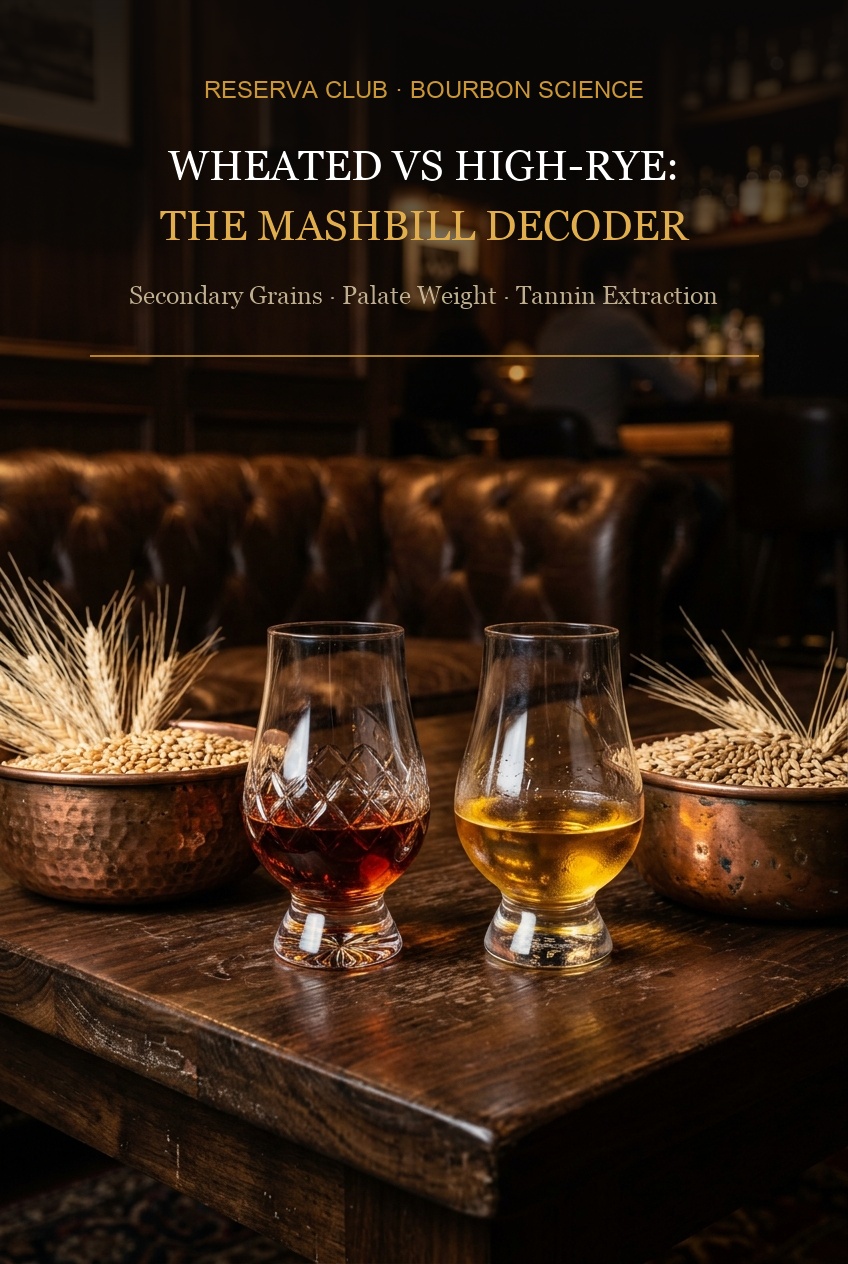
To experience the true biochemical differences between wheat and rye, set up a two-glass blind or semi-blind flight:
- The Setup: Pour 1.0 oz of a benchmark wheated bourbon (e.g., Maker's Mark 46 or Weller Special Reserve) into Glass A, and 1.0 oz of a high-rye bourbon of similar proof (e.g., Four Roses Small Batch or Bulleit) into Glass B.
- Glassware: Use identical crystal glassware such as The Official Glencairn Crystal Whiskey Glass Set or modern Norlan Double-Walled Whisky Tasting Glasses. Allow both pours to rest for 10 minutes to let volatile neck vapors disperse.
- The Nose: Inhale gently with your mouth slightly open. Note the warm brioche and maraschino cherry of Glass A versus the mint sprig, crisp apple, and cinnamon stick of Glass B.
- The Palate Coat: Take a small sip of Glass A and "chew" the whiskey for 5 seconds. Feel how it covers the lateral sides of your tongue in velvet. Cleanse your palate with neutral mineral water, then sip Glass B. Notice the immediate center-palate spice and tingling, dry finish.
Recommended Tasting Glassware & Connoisseur Barware
To evaluate secondary mashbill nuances without olfactory interference, use the barware trusted by professional master distillers:
- The Industry Standard Glass: The Official Glencairn Crystal Whiskey Glass Set — Tapered tulip rim concentrates secondary grain vanillin and rye terpenes directly to the nose.
- Aroma-Enhancing Glasses: Norlan Double-Walled Whisky Tasting Glasses (Set of 2) — Scientifically designed interior fins diminish ethanol vapor intensity while aerating the pour.
- Heavy-Base Rocks Tumblers: Viski Professional Heavy-Base Crystal Tumblers — Exceptional crystal weight for neat pours or large clear ice spheres.
- Oak Aging Staves: Charred American White Oak Aging Staves — Test rapid oak lactone and vanillin extraction curves with your home decanter experiments.
- Precision Cigar Cutter: Colibri V-Cut Premium Cigar Cutter — Deep contoured wedge cut preserves wrapper integrity while drawing smooth smoke against high-rye bourbons.
- Windproof Jet Torch: Xikar Tactical Triple Torch Jet Lighter — High-altitude triple flame torch engineered for even toasting across large ring gauge vitolas.
- Humidor Humidity Packs: Boveda 65% RH 2-Way Humidity Control Packs — Keep your maduro and habano cigars perfectly conditioned for spirit pairings.
Frequently Asked Questions
Is Pappy Van Winkle a wheated bourbon?
Yes. Pappy Van Winkle Family Reserve (15, 20, and 23 Year), along with Van Winkle Special Reserve 12 Year and Old Rip Van Winkle 10 Year, are all produced at the Buffalo Trace Distillery using their proprietary wheated mashbill (the same base mashbill used for the W.L. Weller lineup).
What makes a bourbon "High-Rye"?
There is no strict legal definition for "High-Rye" in the TTB regulations. However, within the distilling industry, standard traditional bourbon contains 10% to 15% rye. Any bourbon recipe with 20% or greater rye content is classified as High-Rye.
Which is sweeter: wheated or high-rye bourbon?
Wheated bourbon tastes noticeably sweeter on the palate. While both styles contain similar levels of residual sugars derived from corn, rye contains spicy, tannic chemical compounds that dry out the palate, whereas wheat allows natural sweetness and vanillin to take center stage.
Can you blend wheated and high-rye bourbon in an infinity bottle?
You can, but proceed with caution. Blending a delicate wheated bourbon into a bold high-rye whiskey often results in the spicy rye phenolics completely overwhelming the soft wheat profile. For best results, keep a dedicated Wheated Infinity Decanter separate from your High-Rye blends.
Build Your Private Whiskey Vault with Reserva Club
Whether your shelf leans toward allocated wheaters or barrel-proof high-rye powerhouses, tracking mashbills, barrel codes, and bottle fill levels shouldn't happen on scattered spreadsheets. Reserva Club provides collectors with a dedicated dual vault to log bourbon bottles, track secondary valuations, and discover AI-matched cigar pairings.
More from The Codex
How to Calibrate a Digital Hygrometer: The 75% Salt Test vs. Boveda One-Step
Read Guide →The Private Syndicate Playbook: How Collectors Pool Allocations, Split Barrels, and Share Vaults
Read Guide →The Master Guide to Infinity Bottles: Solera Math, Proof Calculations, and Blending Chemistry
Read Guide →Proof Equilibrium: The Sommelier Science of Pairing High-Proof Whiskey and Fine Cigars
Read Guide →The Silo Problem: Why the Modern Connoisseur Outgrows Single-Category Apps
Read Guide →I've Owned 11 Humidors. Here's What I Actually Recommend.
Read Guide →
Smoke · Sip · Savor
Track your bottles, fill levels, infinity blends, and real street valuation.
Open My Whiskey Shelf →Reserva Club is reader-supported. When you purchase through links on our site, we may earn an affiliate commission at no extra cost to you. As an Amazon Associate, we earn from qualifying purchases.