The Truth About Finishing Casks: Sherry, Port, Cognac, and Toasted Oak Staves
Behind the secondary maturation craze. Wood porosity, rancio development, Pedro Ximénez sweetness vs French oak tannins, and how cask finishes interact with premium cigar smoke.
Table of Contents
- The Legal Landscape: What the TTB Dictates
- The Physics of Stave Imbibition: How the Barrel Drinks and Gives
- Deconstructing the Primary Finishing Casks
- Finishing Cask Comparison Chart
- The Connoisseur's Warning: Finish-Washing vs. Master Maturation
- Cigar Pairing Synergy: Matching Finishes with Vitolas
- Recommended Cask Tasting Glassware & Cellar Accessories
- Frequently Asked Questions
- Track Your Bottle Allocations with Reserva Club
For over a century, Kentucky Straight Bourbon was defined by a strict, puritanical legal code: distilled from at least 51% corn and aged exclusively in brand-new, charred American white oak containers. Nothing added, nothing taken away.
Then came the secondary maturation revolution.
Today, liquor store shelves and collector auctions are filled with bourbons that have spent six months, two years, or even half a decade resting in barrels that previously held Spanish Oloroso sherry, Portuguese Ruby port, French Cognac, Jamaican rum, or flame-toasted virgin oak staves. Brands from Angel's Envy and Bardstown Bourbon Company to Blood Oath and Woodford Reserve command premium secondary prices for these finished expressions.
Yet among purists, debate rages: Are finishing casks the ultimate frontier of flavor complexity, or a clever marketing smoke-screen used to mask immature, thin distillate?
In this master guide, we examine the legal boundaries of secondary cask finishing, deconstruct the physical chemistry of stave imbibition, analyze the distinct sensory signatures of fortified wines and French oak, and explore how cask-finished bourbons pair with full-bodied cigars.
The Legal Landscape: What the TTB Dictates
In the United States, the Alcohol and Tobacco Tax and Trade Bureau (TTB) maintains rigid Class and Type designations for distilled spirits.
Under federal regulations:
- The Pure Definition: To be labeled "Kentucky Straight Bourbon Whiskey," the spirit must age in new charred oak containers.
- The Finish Clause: Once a straight bourbon is transferred into a secondary used barrel (such as a port pipe or sherry butt), it legally ceases to be pure straight bourbon. Under TTB Class 101, it must be designated either as:
- "Straight Bourbon Whiskey Finished In [Cask Type]" (if the base spirit met all straight bourbon requirements prior to finishing), or
- "Distilled Spirits Specialty" (if additional flavors or blending boundaries are crossed).
Federal regulations forbid the addition of artificial colorings or liquid flavoring extracts to straight bourbon. Therefore, every drop of fruit, nut, and wine character in a legally finished bourbon must be naturally extracted directly from the porous wood of the secondary cask.
The Physics of Stave Imbibition: How the Barrel Drinks and Gives
How does a secondary cask impart deep mahogany color, dark fruit esters, and velvety sweetness to an already-aged whiskey?
The answer lies in wood porosity and liquid imbibition.
    [ Charred Virgin American Oak ]
              │
     Initial 4–8 Year Aging
              │
              ▼
    Base Straight Bourbon (Vanilla, Caramel, Char)
              │
              ▼
    [ Secondary Cask: European Oak / Port / Sherry ]
              │
   High-Proof Ethanol (55%–62% ABV) Acts as Solvent
   Leaches 2–10 Gallons of "Devil's Cut" From Wood Pores
              │
              ▼
    Finished Master Bourbon (Dark Fruit, Rancio, Velvet Finish)
European vs. American Oak Anatomy
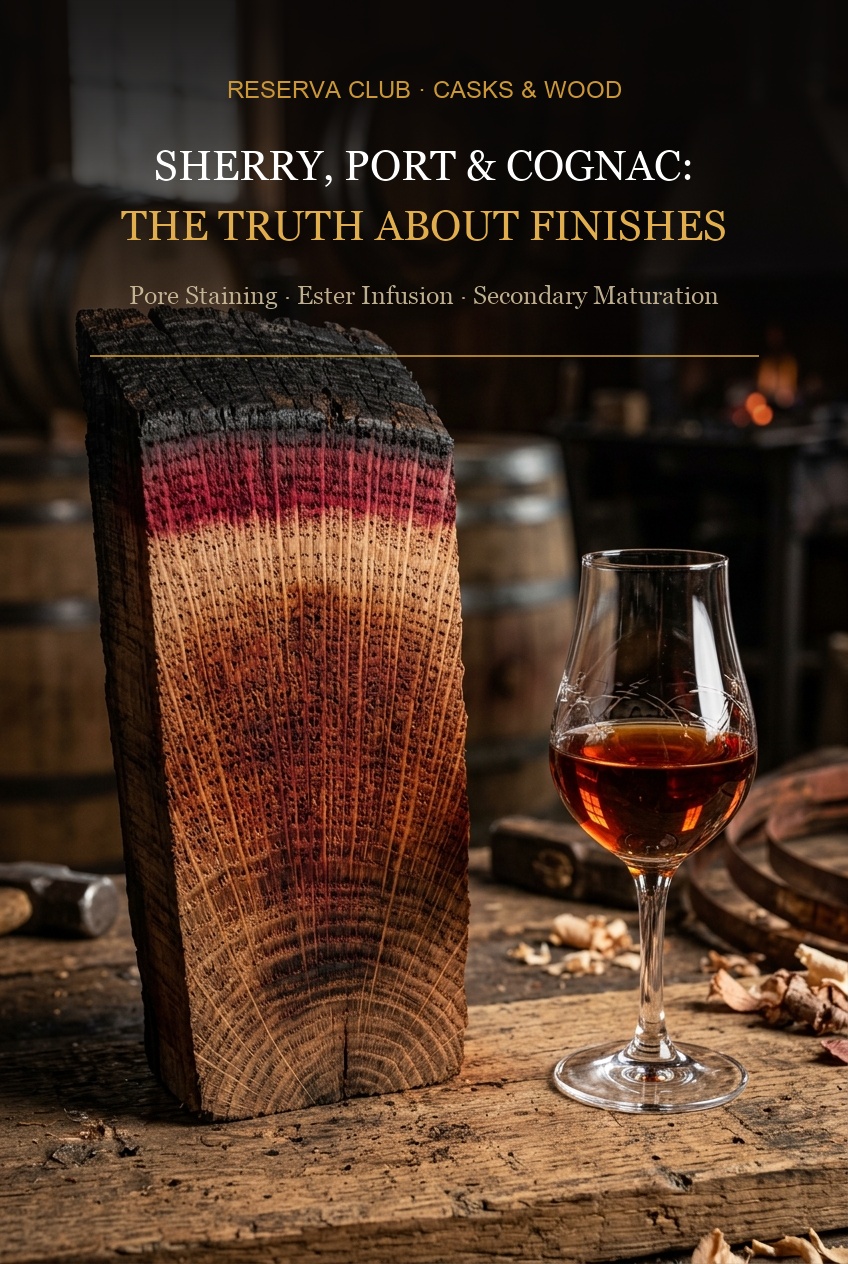
While American bourbon barrels use American white oak (Quercus alba), European wine, sherry, and cognac casks typically use European pedunculate or sessile oak (Quercus robur or Quercus petraea):
- American Oak (Q. alba): Features tight cellular structures and high levels of tyloses—balloon-like vascular outgrowths that plug the xylem conduits, making the wood completely watertight. American oak is rich in vanillin and sweet lactones.
- European Oak (Q. robur): Significantly more porous, with wide vascular rings and higher grain permeability. It contains lower vanillin but up to five times more hydrolyzable tannins, gallic acid, and ellagitannins.
The "Devil's Cut" Extraction
When a 500-liter sherry butt or 600-liter port pipe is emptied in Spain or Portugal, the wood staves remain thoroughly saturated. Deep inside the micro-pores of the oak staves sits between 2 and 10 gallons of residual fortified wine that cannot be drained—known as the wood's imbibed liquid or "devil's cut."
When aged bourbon enters that cask at 110 to 125 proof (55% to 62.5% ABV), the high-proof ethanol acts as a powerful organic solvent. Over months of thermal expansion and contraction, the whiskey penetrates into the wood pores, dissolving the trapped wine compounds, fruit acids, glycerol, and oxidized esters, pulling them out into the whiskey.
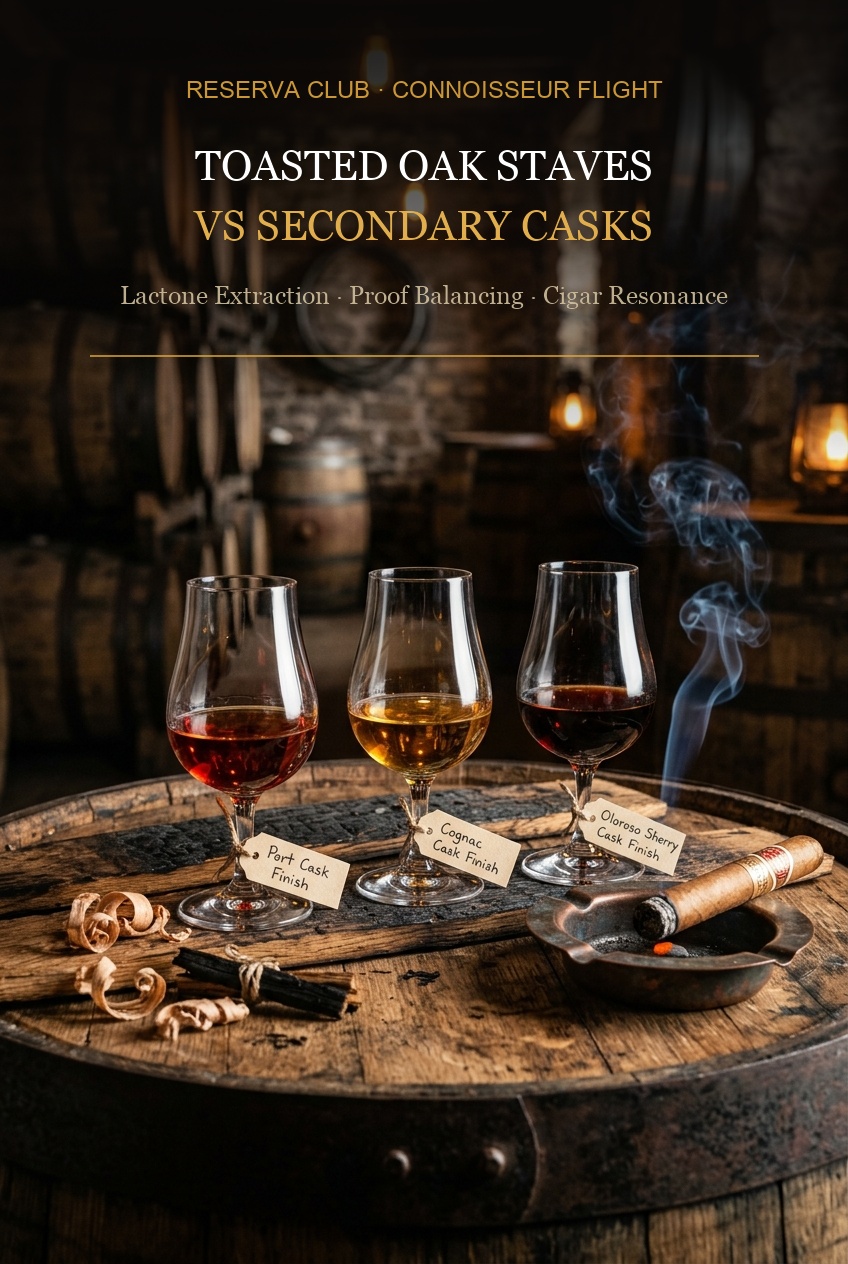
Deconstructing the Primary Finishing Casks
Not all casks yield the same flavor profile. A connoisseur must understand the distinct chemical signature of each finish:
1. Sherry Casks (Oloroso vs. Pedro Ximénez)
Sherry is a fortified Spanish wine produced in the Jerez-Xérès-Sherry triangle under a dynamic solera system:
- Oloroso Sherry (The Dry, Nutty Benchmark): Fortified to 17%–18% ABV, oloroso ages oxidatively without a yeast cap (flor). It infuses bourbon with deep amber-red tones, roasted hazelnuts, dried figs, dark raisins, tobacco leaf, and savory rancio (the complex, earthy, umami character developed through decades of wood oxidation).
- Pedro Ximénez / PX (The Viscous Sweet Bomb): Made from sun-dried white grapes, PX sherry is intensely sweet, syrupy, and dark. Bourbons finished in PX casks develop heavy, dessert-like notes of molasses, dark plum, chocolate fudge, and candied dates.
2. Port Casks (Tawny vs. Ruby)
Hailing from Portugal's Douro Valley, port is fortified with grape spirit (aguardente) during fermentation:
- Ruby Port: Aged briefly in large oak vats with minimal oxygen contact. Imparts vibrant, juicy flavors of fresh red berries, blackberries, ripe black cherries, and sweet grape jam with bright fruit acidity.
- Tawny Port: Aged for decades in smaller wooden pipes with continuous oxygen interaction. Infuses bourbon with refined notes of toasted almonds, orange marmalade, dried apricot, baking spices, and butterscotch.
3. Cognac Casks (French Limousin Oak)
Cognac is double-distilled white wine aged in fine-grained French Limousin or Tronçais oak:
- Rather than delivering heavy sweetness, Cognac finishing provides aristocratic elegance.
- The spirit extracts floral violet, white peach, stewed pear, clove, and silky French oak tannins. It drys the finish slightly while elongating the mid-palate complexity.
4. Toasted Oak Staves (The Secondary Virgin Oak Movement)
Pioneered commercially by Maker's Mark 46 and elevated by Michter's Toasted Barrel Finish, this process does not use wine or spirit casks.
Instead, fully matured bourbon is finished in virgin American white oak barrels (or submerged with specialized Charred American White Oak Aging Staves) that have undergone prolonged convective infrared toasting without being open-flame charred.
- Charring (Level 3 or 4): Burns the wood surface into carbonized "alligator scale," which acts as a carbon filter to remove sulfur compounds and create basic caramel.
- Convective Toasting: Gently heats the wood deep into its cellulose core without burning it. This thermal breakdown (pyrolysis) synthesizes massive quantities of vanillin, furfural (yielding sweet toasted almond and caramel), and cis-oak lactones (yielding rich sweet cream and coconut).
Finishing Cask Comparison Chart
| Cask Finish | Wood Origin | Primary Flavor Markers | Optimal Finish Duration | Legendary Expression |
|---|---|---|---|---|
| Oloroso Sherry | European Oak (Q. robur) | Roasted walnut, dried fig, leather, rancio | 6 to 18 Months | Thomas S. Moore Oloroso, Joseph Magnus |
| Pedro Ximénez | European / American Oak | Dark molasses, prune, chocolate, date | 4 to 12 Months | Bardstown Collaborative PX Sherry |
| Tawny Port | Portuguese Oak (Q. faginea) | Stewed plum, blackberry, dried apricot | 6 to 24 Months | Angel's Envy Finished Rye, Blood Oath Pact 8 |
| Cognac | French Limousin Oak | Pear, white peach, baking spice, dry oak | 8 to 24 Months | Woodford Reserve Master's Cognac Finish |
| Toasted Virgin Oak | American White Oak | Toasted marshmallow, vanilla bean, coconut | 3 to 8 Months | Michter's Toasted Barrel, Maker's Mark 46 |
The Connoisseur's Warning: Finish-Washing vs. Master Maturation
While secondary finishes can elevate exceptional bourbon into a work of art, finishing casks are also susceptible to exploitation in the spirits industry.
Known as "finish washing," some non-distilling producers take cheap, grain-neutral, 2-year-old corn whiskey that is harsh, astringent, and immature, and drown it in an intensely sweet Pedro Ximénez or Muscatel wine cask for six months. The resulting spirit turns purple-brown and tastes like spiked pancake syrup.
How to Spot a Masterpiece vs. a Masked Defect:
- The Finish Balance: In an authentic master-finished whiskey, the base bourbon (charred oak, sweet corn, vanilla, and rye spice) remains clearly recognizable. The cask finish acts as a complementary top-coat, not a disguise.
- The ABV Anchor: Top-tier finishes are usually bottled at higher proof points (100 to 115+ proof). Higher ABV preserves the structural integrity of the base bourbon against the heavy fruit sugars of the wine cask.
- Mid-Palate Hollows: If a whiskey has a burst of sweet wine on the front of the tongue, followed by a total drop-off in flavor and a bitter, acetone finish, you are tasting finish-washed young grain.
Cigar Pairing Synergy: Matching Finishes with Vitolas
Cask-finished bourbons offer some of the most dynamic pairing possibilities in the cigar world:
1. Port & PX Sherry Finishes with Mexican San Andrés Maduro
- The Cigar: Thick, dark maduro leaf (such as an Oliva Serie V Melanio Maduro or Liga Privada No. 9).
- The Synergy: The rich, dark cocoa and roasted coffee profile of the Mexican wrapper creates a classic dessert resonance with the dark blackberry, prune, and fig sweetness of port and PX sherry casks. It tastes like dark chocolate-covered cherries.
2. Cognac & French Oak Finishes with Cameroon Wrappers
- The Cigar: African Cameroon leaf (such as Arturo Fuente Don Carlos).
- The Synergy: Cameroon wrappers are prized for their subtle baking spices, cinnamon, and dry cedar. The floral, peach, and polished French oak tannins of a Cognac-finished bourbon match the dry elegance of the Cameroon wrapper without drowning out its delicate nuances.
Recommended Cask Tasting Glassware & Cellar Accessories
To dissect secondary wine, port, and toasted oak finishes like a professional spirits judge:
- Official Tasting Copita: Official Glencairn Crystal Copita Tasting Glasses with Caps — Includes a crystal tasting cap to trap delicate fruit esters and rancio aromas inside the bowl before nosing.
- Crystal Whiskey Snifters: Viski Heavy-Base Crystal Whiskey Snifters (Set of 2) — Wide bowl accelerates evaporation of dark fruit and wine cask esters into the nasal cavity.
- Home Barrel Aging Staves: Charred American White Oak Aging Staves — Replicate toasted barrel finishing in small glass vessels with genuine charred white oak.
- Clear Ice Sphere Maker: Tovolo Seamless Clear Ice Sphere Molds — High-density 2-inch ice spheres melt slowly without watering down rich cask-finished proof.
- Luxury Desktop Ashtray: Colibri Quasar Luxury Metal Cigar Ashtray — Heavy cast metal geometric ashtray designed for multi-cigar tasting sessions with fellow collectors.
- Precision Humidity Regulation: Boveda 65% RH Humidity Control Packs — Keeps maduro and broadleaf cigars in prime condition to pair against rich port and sherry finishes.
Frequently Asked Questions
Does finishing bourbon in a wine cask make it sweet like wine?
It adds perceived sweetness and rich, round mouthfeel due to unfermentable sugars and glycerol extracted from the wood pores, but it remains a full-strength distilled spirit. A high-quality finished bourbon will never taste cloying or syrupy.
How long does a secondary finish take?
Finishing windows range from a few weeks up to several years. In active, wet sherry or port casks, an aggressive extraction can occur in as little as 4 to 8 months. Cognac and toasted oak barrels often require 12 to 24 months of slow extraction.
Is Angel's Envy considered straight bourbon?
Because Angel's Envy finishes its bourbon in port wine casks, it is legally labeled as "Kentucky Straight Bourbon Whiskey Finished in Port Wine Barrels."
Track Your Bottle Allocations with Reserva Club
Whether your vault houses rare toasted-barrel releases or allocated wine-finished collaborations, logging batch details, finishing woods, and tasting notes is essential for serious collectors. Reserva Club offers an exclusive dual-vault tracking platform built specifically for fine bourbon and cigar connoisseurs.
More from The Codex
Tobacco Beetles (Lasioderma serricorne): Identification, Freezing Protocol, and Cellar Quarantine
Read Guide →The Connecticut Shade Morning Ritual: Pairing Mild Cigars with Espresso & Wheated Bourbon
Read Guide →Wheated vs. High-Rye Bourbon: Decoding Mashbills, Palate Weight, and Finish
Read Guide →How to Calibrate a Digital Hygrometer: The 75% Salt Test vs. Boveda One-Step
Read Guide →The Private Syndicate Playbook: How Collectors Pool Allocations, Split Barrels, and Share Vaults
Read Guide →The Master Guide to Infinity Bottles: Solera Math, Proof Calculations, and Blending Chemistry
Read Guide →
Smoke · Sip · Savor
Track your bottles, fill levels, infinity blends, and real street valuation.
Open My Whiskey Shelf →Reserva Club is reader-supported. When you purchase through links on our site, we may earn an affiliate commission at no extra cost to you. As an Amazon Associate, we earn from qualifying purchases.