Habano Wrappers & Cask-Strength Rye: Why Peppery Leaf Cuts High Proof
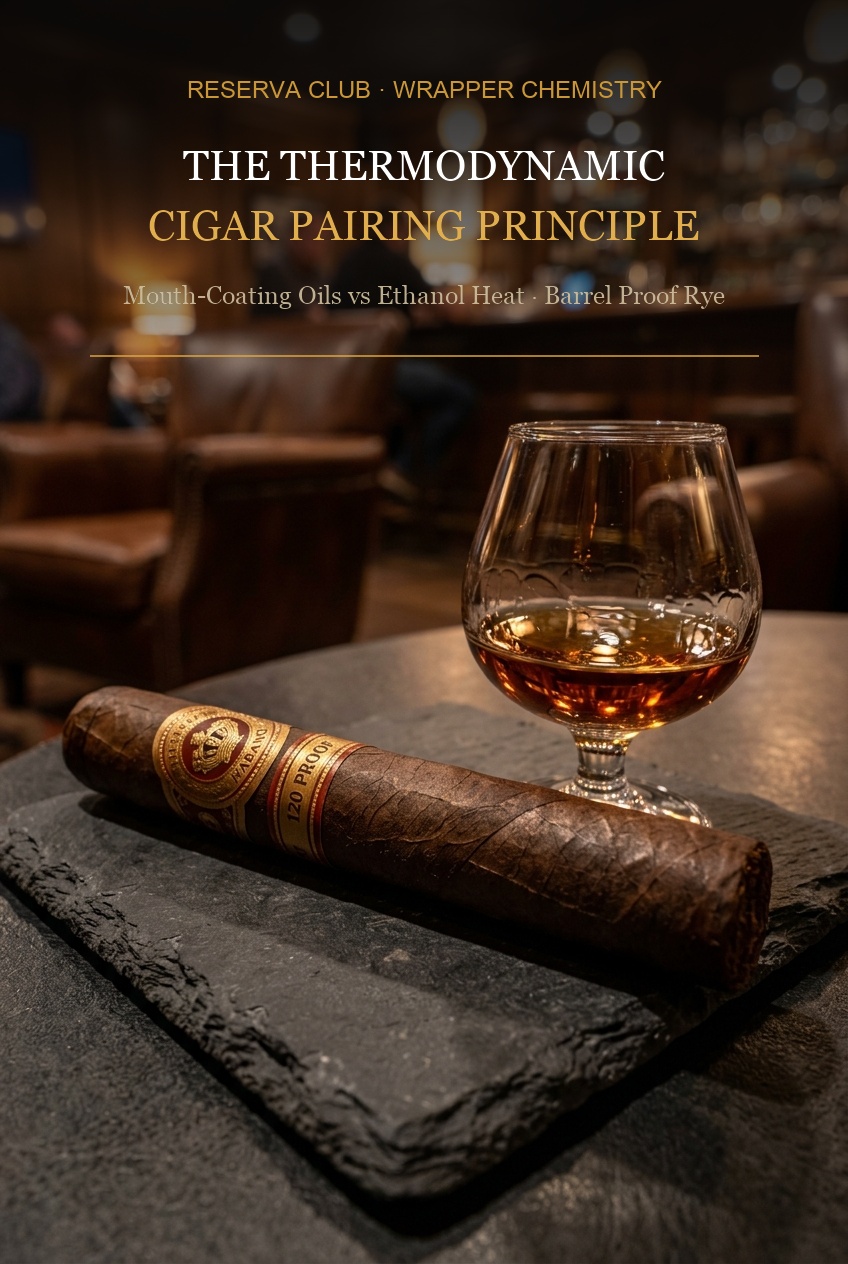
The thermodynamic pairing principle. How the high oil density and spicy 4-vinylguaiacol of Nicaraguan Habano wrappers counteract the ethanol vapor of 120+ proof cask-strength rye.
Table of Contents
- The High-Proof Dilemma: What Ethanol Does to the Tongue
- The Botanical Armor: The Sun-Grown Habano Leaf
- The Thermodynamic Principle: Oil Density vs. Ethanol Heat
- The 4-Step Sip-Draw Sequence
- The Hall of Fame: Benchmark Pairings
- Recommended High-Proof Glassware & Cigar Accessories
- Frequently Asked Questions
- Log Your Pairings in the Reserva Club Vault
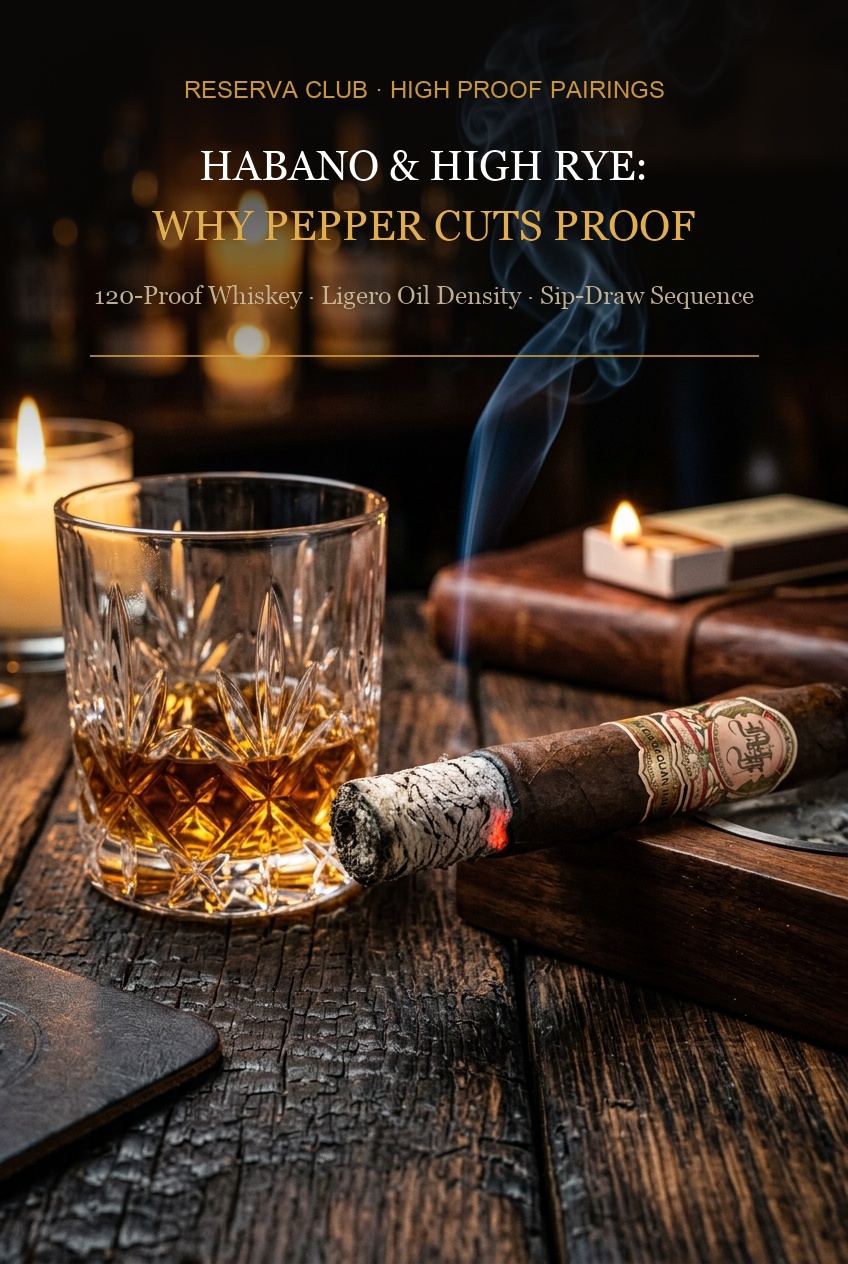
Pouring a glass of 120-proof (60% ABV) uncut, unfiltered cask-strength rye whiskey is an act of sensory bravery. At that alcohol concentration, volatile ethanol vapor aggressively hits the trigeminal nerve endings of your tongue and sinuses, creating an immediate fiery burn.
Light up a mild, delicate cigar in an attempt to tame that heat, and disaster ensues: the ferocious alcohol fire incinerates the subtle tobacco flavors, leaving your palate numb and your cigar tasting like bitter ash.
Yet place that same 120-proof barrel-proof rye next to a dark, toothy, oil-drenched Nicaraguan Habano cigar, and an astonishing biochemical transformation occurs.
The sharp sting of ethanol vanishes. The perceived alcohol burn drops by half. Suddenly, your palate is flooded with notes of blood orange marmalade, dark baker's chocolate, toasted caraway, cracked peppercorns, and antique leather.
This is not magic—it is the Thermodynamic Pairing Principle.
In this master guide, we deconstruct the botanical density of sun-grown Habano wrapper leaves, examine how tobacco oils buffer the tongue against high-proof ethanol, and reveal the exact 4-Step Sip-Draw Sequence to conquer cask-strength spirits.
The High-Proof Dilemma: What Ethanol Does to the Tongue
To understand why this pairing works, you must look at how the human mouth processes spirits bottled at cask strength (typically between 110 and 130 proof / 55%–65% ABV).
When liquid at 60% ABV contacts the oral mucosa:
- Salivary Denaturation: High-concentration ethanol rapidly draws water out of oral epithelial cells, causing salivary proteins to precipitate. This leaves the surface of the tongue dry and vulnerable.
- Trigeminal Nerve Activation: Ethanol binds directly to the TRPV1 receptor (the exact same heat-sensing receptor activated by capsaicin in chili peppers). Your brain registers this chemical reaction not as a flavor, but as physical thermal combustion.
- Olfactory Vapor Blindness: As warm body temperature vaporizes ethanol in the oral cavity, high-velocity alcohol molecules rush up the nasopharynx into the olfactory bulb, temporarily blinding your sensory receptors to delicate ester notes.
If your companion cigar is thin or mild, it has zero defensive capability against this chemical assault. It is wiped out in a single sip.
The Botanical Armor: The Sun-Grown Habano Leaf
To fight fire, you need armor. In the cigar world, that armor is the Habano wrapper.
Originally derived from Cuban seed strains (Habano 2000, Criollo 98, and Corojo 99), the Habano leaf found its modern spiritual home in the rich volcanic terroirs of Nicaragua—specifically the sun-drenched valleys of Estelí, Condega, and Jalapa.
Why the Habano Leaf is Built Differently:
- Full Solar Exposure: Unlike Connecticut Shade tobacco grown under protective cheesecloth, Habano is typically grown in open, blazing sunlight. To protect itself from harsh UV radiation, the tobacco plant develops a thick, rugged, leathery cellular structure.
- Essential Oil & Resin Density: Sun-grown Habano leaves produce massive concentrations of protective natural plant oils, lipids, and waxes. Look closely at a vintage Padron or My Father Habano: the wrapper is glistening, "toothy" (studded with tiny microscopic oil pockets), and cool to the touch.
- Chemical Profile: Habano tobacco is naturally high in 4-vinylguaiacol, nicotine, and dark resins. It delivers deep, rustic, peppery spice, roasted espresso bean, leather, and wood smoke.
       [ 120-Proof Cask Rye ]                    [ Oily Habano Leaf ]
       Aggressive Ethanol Heat                   Lipophilic Essential Oils
       Activates TRPV1 Burn                      Dense Volatile Resins
                 │                                         │
                 ▼                                         ▼
                 └───────────────┬─────────────────────────┘
                                 │
                                 ▼
                     [ THERMODYNAMIC EQUILIBRIUM ]
                     • Tobacco Lipids Coat & Buffer Papillae
                     • Alcohol Burn Muted by 50%
                     • Unlocks Mint, Chocolate & Blood Orange
The Thermodynamic Principle: Oil Density vs. Ethanol Heat
Here is the secret of the pairing: Lipids neutralize alcohol burn.
When you smoke a rich Habano cigar, the combustion of its resinous wrapper releases heavy, aerosolized lipophilic (oil-soluble) tobacco compounds into your mouth. These dense, warm oils coat your tongue, gums, and palate in a micro-thin, protective organic lipid film.
When you take a sip of cask-strength rye immediately following a Habano draw:
- The Thermal Buffer: The micro-thin oil film acts as a physical insulating barrier between the raw ethanol molecules and your sensitive TRPV1 receptors. The initial alcohol "bite" is dramatically cushioned.
- Volatile Solvent Extraction: Instead of burning your tongue, the 120-proof ethanol acts as a solvent that dissolves and activates the heavy tobacco oils on your palate, releasing deep chocolate, cedar, and espresso flavors that smoke alone could never liberate.
- Resonant Spice Synergy: Rye whiskey’s signature botanical compounds—terpenes, eugenol (clove), and ferulic acid derivatives—share the exact same chemical wavelength as the spicy 4-vinylguaiacol in the Habano wrapper. Rather than fighting each other, the pepper of the cigar and the spice of the rye synthesize into a harmonious, resonant flavor symphony.
The 4-Step Sip-Draw Sequence
Drinking cask-strength rye while smoking requires technical discipline. Gulping whiskey and puffing rapidly will blow out your palate in ten minutes. Follow the Connoisseur's 4-Step Cadence:
Step 1: The Kentucky Chew Priming Sip
Before taking your first cigar puff, take a quarter-ounce sip of your cask-strength rye. Do not swallow immediately—roll the whiskey across your tongue for three seconds (the "Kentucky Chew") and swallow. This triggers your salivary glands to flood the mouth with protective saliva and accustoms your palate to the baseline proof.
Step 2: The Cool Habano Draw
Take a single, slow, deliberate draw from your Habano cigar. Keep the combustion cool—a hot ember burns away the delicate wrapper oils. Hold the smoke in your mouth for three full seconds, allowing the dense tobacco oils to fully coat the lateral sides of your tongue. Exhale gently.
Step 3: The 30% Retrohale
On your second puff, push roughly 30% of the smoke out through your nasal cavity. Notice the invigorating prickle of white pepper, Spanish cedar, and roasted almond in your sinuses.
Step 4: The Immediate Cask-Strength Counter
Within five seconds of exhaling the smoke—while your tongue is still blanketed in tobacco oils—take a small sip of the rye.
Notice what happens: there is zero alcohol burn. The fiery spirit feels rich, sweet, and oily. The mint, dill, and black pepper of the rye seamlessly mesh with the earthy leather and dark cacao of the Habano, finishing with a radiant, warm glow that lasts for over two minutes.
The Hall of Fame: Benchmark Pairings
To experience this synergy at its highest level, pair these world-class vitolas with benchmark high-proof American ryes:
| Cigar Vitola | Wrapper & Origin | Cask-Strength Rye Pour | Proof | Pairing Notes |
|---|---|---|---|---|
| Padron 1926 Serie No. 9 | Nicaraguan Habano Natural | Wild Turkey Rare Breed Rye | 112.2° | Dark chocolate, orange zest, clove, leather |
| My Father Le Bijou 1922 | Oscuro Habano (Ecuador) | Thomas H. Handy Sazerac Rye | ~126°+ | Bold black pepper, molasses, mint, candied ginger |
| Oliva Serie V (Double Robusto) | Sun-Grown Habano (Jalapa) | Michter's Barrel Strength Rye | ~110°+ | Rich cedar, vanilla cream, pumpernickel bread |
| Tatuaje Selección de Cazador | Ecuadorian Habano | Pinhook Vertical Series Rye | ~118° | Earthy spice, leather, citrus peel, baking cinnamon |
| Liga Privada Único Papas Fritas | Brazilian Mata Fina / Habano | Willett Family Estate 4-Yr Rye | ~114° | Campfire oak, dark roast coffee, spearmint sprig |
⚡ Featured High-Proof Tasting Provisions:
- Nicaraguan Powerhouse Event: If you are seeking full-bodied Nicaraguan leaf engineered to stand toe-to-toe with 115°+ proof rye, Famous Smoke Shop is currently running up to 34% off plus a FREE 8-Cigar Joya Sampler ($92 retail value) on Joya de Nicaragua Boxes.
- Broadleaf & Habano Heavy-Hitters: For dark, peppery Nicaraguan rustic blends, score a FREE Nica Rustica Sampler on select Drew Estate Nica Rustica Boxes.
Recommended High-Proof Glassware & Cigar Accessories
Taming 120-proof barrel strength spirits with toothy Habano leaves requires heavy-duty connoisseur hardware:
- Cut Crystal Rocks Tumbler: Marquis by Waterford Heavy Cut Crystal Double Old Fashioned Glasses — Thick crystal base provides solid thermal insulation and hand weight for uncut spirits.
- Official Glencairn Glass Set: The Official Glencairn Crystal Whiskey Glass Set — Allows precision nosing of volatile rye baking spices and mint terpenes.
- Deep Contoured Cigar Cutter: Colibri Deep V-Cut Cigar Cutter — Clean, deep wedge draw channels dense Habano smoke directly over the tongue's lateral taste receptors.
- Windproof Double Jet Lighter: Xikar Allume Double Torch Jet Lighter — Pinpoint double flame torch ensures an even, slow burn across thick Nicaraguan Habano wrappers.
- Heavy Ceramic Lounge Ashtray: Mantello Cast Heavy Ceramic 4-Cigar Ashtray — Deep basin holds thick white ash columns without blowing residue across the tasting table.
- Humidor Humidity Protection: Boveda 65% RH 2-Way Humidity Control Packs — Ensures dense ligero leaves burn cool and never overheat into caustic bitterness.
Frequently Asked Questions
Can I pair high-proof bourbon instead of rye with a Habano?
Yes. Cask-strength high-rye bourbons (such as Four Roses Single Barrel Barrel Strength or Old Grand-Dad 114) perform exceptionally well. However, dedicated Straight Rye Whiskey (51%+ rye grain) contains higher concentrations of crisp botanical terpenes, providing a sharper, cleaner cut through dense tobacco oils than sweet corn-heavy bourbons.
Should I add water to my rye whiskey when pairing?
Start the first third of your cigar with the rye completely neat at uncut cask strength. If your palate begins to fatigue as the cigar intensifies in its final third, add two to three drops of distilled water. This releases aromatic wood esters and drops the alcohol heat, preserving your palate to the nub.
Why do some Habano wrappers taste harsh instead of peppery?
Harshness is usually a symptom of poor storage or smoking too fast. If a Habano cigar is stored above 70% RH, excess moisture creates steam during combustion, resulting in a bitter, caustic draw. Store your Habanos at 64% to 66% RH using Boveda 65% RH 2-Way Humidity Control Packs for a clean, sweet, peppery burn.
Log Your Pairings in the Reserva Club Vault
Mastering the interaction between barrel-proof spirits and world-class cigars is the hallmark of a true aficionado. With Reserva Club, you can record your tasting sessions, link specific bottle proofs to individual cigar vitolas, and share your private cellar scores with fellow collectors.
More from The Codex
The Truth About Finishing Casks: Sherry, Port, Cognac, and Toasted Oak Staves
Read Guide →Tobacco Beetles (Lasioderma serricorne): Identification, Freezing Protocol, and Cellar Quarantine
Read Guide →The Connecticut Shade Morning Ritual: Pairing Mild Cigars with Espresso & Wheated Bourbon
Read Guide →Wheated vs. High-Rye Bourbon: Decoding Mashbills, Palate Weight, and Finish
Read Guide →How to Calibrate a Digital Hygrometer: The 75% Salt Test vs. Boveda One-Step
Read Guide →The Private Syndicate Playbook: How Collectors Pool Allocations, Split Barrels, and Share Vaults
Read Guide →
Smoke · Sip · Savor
Ready to track your cigars, aging dates, and humidor collection?
Start My Digital Humidor →Reserva Club is reader-supported. When you purchase through links on our site, we may earn an affiliate commission at no extra cost to you. As an Amazon Associate, we earn from qualifying purchases.