The Neck Pour Myth: How Headspace Oxidation Changes High-Proof Bourbon Over 90 Days
Why freshly cracked barrel-proof bourbons often taste tight, astringent, or ethanol-hot on night one—and the real chemistry of headspace oxidation as your bottle drops to the shoulder.
Table of Contents
Every serious bourbon collector has experienced it: you hunt down a bottle of 125-proof single barrel bourbon for months, finally pop the cork on Friday night, pour the very first ounce out of the narrow glass neck—and it tastes like pure liquid fire, dry oak astringency, and closed-off ethanol heat.
Three weeks later, you return to that exact same bottle with three friends. Suddenly, the sharp alcohol sting has vanished, replaced by lush layers of dark cherry cordial, crème brûlée, toasted pecan, and warm baking spice.
In whiskey circles, that harsh initial dram is famously called "The Neck Pour." Skeptics argue that liquid inside a bottle is homogeneous and cannot stratify in the neck, while seasoned drinkers swear that a bottle "opens up" dramatically after the first two or three pours.
Both sides are right—for completely different scientific reasons. In this master guide, we separate folklore from organic chemistry, explaining how headspace oxidation, volatile sulfur flash-off, and surface-area geometry transform high-proof bourbon over 30 to 90 days.
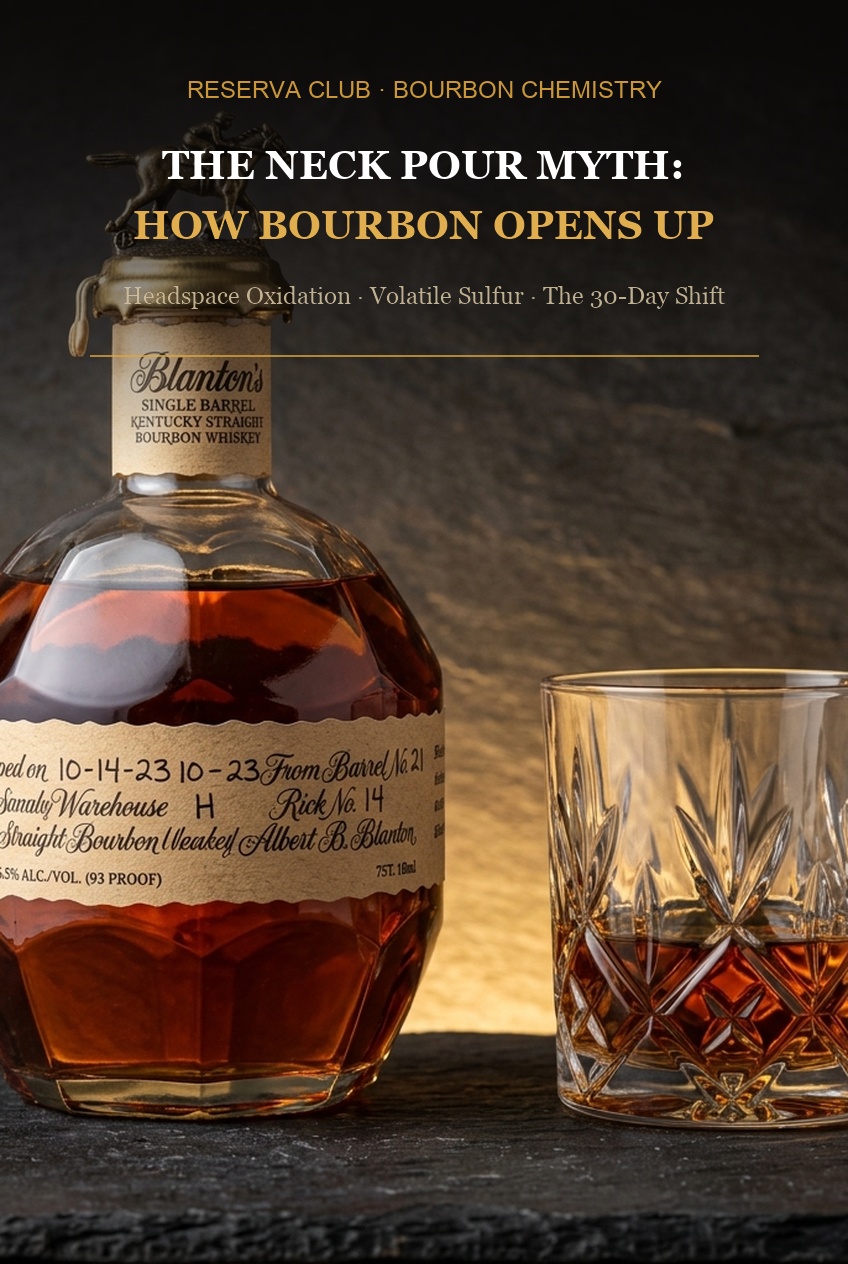
Why the First Pour Tastes Different (It Isn't Gravity—It's Headspace)
Physically, the whiskey sitting in the narrow neck of a sealed bottle is chemically identical to the whiskey at the bottom of the glass. Ethanol and water form a miscible solution; high-proof alcohol does not float to the top of the neck like cream on milk.
So why does the first pour out of a newly cracked bottle so often taste tight, hot, and one-dimensional?
1. Trapped Volatile Compounds in the Tiny Neck Headspace
When a bottle is filled on the bottling line and sealed with a natural cork, only a few cubic centimeters of air remain trapped in the narrow neck. Highly volatile, low-boiling-point compounds—including acetaldehyde, ethyl acetate (which smells like nail polish remover in high concentrations), and trace sulfur compounds—reach vapor equilibrium inside that tiny headspace.
The moment you pull the cork and immediately pour into your glass, those trapped volatile vapors rush straight into your nostrils alongside un-aerated, high-proof spirit.
2. Zero Dissolved Oxygen Equilibrium
As soon as you pour the first 2 to 3 ounces out of the bottle, two critical geometric shifts happen simultaneously:
- The Surface Area Expands by 400%: The liquid line drops out of the narrow 1-inch neck down into the wide 3.5-inch shoulder of the bottle, quadrupling the surface area of whiskey exposed to oxygen.
- The Air-to-Liquid Ratio Multiplies: Fresh atmospheric oxygen ($O_2$) is now sealed inside the bottle above the spirit. Over the next 14 to 30 days, slow oxidative reactions convert harsh aldehydes and volatile sulfur notes into softer aromatic esters—unlocking vanilla, caramel, dried fig, and milk chocolate.
The 90-Day Evolution Timeline of an Opened Bottle
Not all whiskeys react to air at the same speed. A 90-proof chill-filtered shelf bourbon changes very little after opening, whereas an uncut, unfiltered cask-strength bourbon (110°–135° proof) undergoes a dramatic three-month arc:
| Time Since First Crack | Bottle Fill Level | Sensory Profile & Palate Shift |
|---|---|---|
| Day 1 (Fresh Crack) | 95% (Neck) | High ethanol vapor, tight oak tannins, sharp trigeminal heat |
| Days 14 – 30 | 75% – 85% (Shoulder) | The Sweet Spot Opens: Ethanol edge softens; fruit & vanilla esters bloom |
| Days 30 – 90 | 40% – 75% (Mid-Bottle) | Peak Complexity: Rich mouthfeel, integrated oak, maximum aromatic depth |
| 12+ Months | Below 25% (Heel) | Danger zone for over-oxidation; volatile top notes begin to flatten |
The Connoisseur's Protocol for Fresh Cracks
If you are opening a prized allocated bottle or high-proof single barrel tonight and want it to drink at its peak immediately without waiting three weeks, follow this three-step protocol:
1. The "One Minute Per Year" Glass Rest
Pour 1.5 ounces into a tulip-shaped Official Glencairn Crystal Whiskey Glass Set or an aerating double-walled Norlan Whisky Glass and let it sit untouched on the table for 10 to 15 minutes (roughly one minute for every year the whiskey spent in oak). Gently swirl the glass once at the five-minute mark to flash off volatile ethyl acetate.
2. Drop the Bottle to the Shoulder
When cracking a notoriously tight barrel-proof bottle (such as Elijah Craig Barrel Proof, Stagg, or Weller Full Proof), pour two glasses on night one to drop the fill level just into the wide shoulder of the bottle, then recork it and revisit in two weeks.
3. Protect the "Heel" When a Bottle Drops Below 25%
Once a bottle falls below a quarter full, the massive air volume inside the bottle will slowly strip away delicate aromatics over several months. Either transfer the remaining ounces into a 2-ounce Boston round sample bottle, or blend the final pour into your Crystal Whiskey Infinity Decanter.
Frequently Asked Questions
Does bourbon "go bad" after you open the bottle?
Unlike wine, high-proof distilled spirits do not spoil or turn to vinegar. As long as a bottle is stored upright away from direct sunlight and remains above 30% full with a tight cork, it will stay delicious for 2 to 5+ years.
Why should I never store bourbon on its side like wine?
Wine is ~13% ABV and requires a wet cork to stay sealed. Bourbon is 45% to 65%+ ABV—high-proof alcohol is a powerful solvent that will dissolve natural cork glue, taint the whiskey with bitter corked flavors, and cause the stopper to crumble. Always store whiskey upright.
Track Your Bottle Fill Levels & Tasting Evolution in Reserva Club
Want to remember how a bottle tasted on Fresh Crack night versus Day 30? Inside Reserva Club, you can log every bottle on your shelf, track open dates and fill levels, and compare your tasting scores over time.
More from The Codex
The Tupperdor Blueprint: Why Airtight Acrylic & 62% Boveda Beat Cheap Wood Humidors
Read Guide →Blind Tasting 101: How to Host an Unbiased Whiskey Flight at Home
Read Guide →Habano Wrappers & Cask-Strength Rye: Why Peppery Leaf Cuts High Proof
Read Guide →The Truth About Finishing Casks: Sherry, Port, Cognac, and Toasted Oak Staves
Read Guide →Tobacco Beetles (Lasioderma serricorne): Identification, Freezing Protocol, and Cellar Quarantine
Read Guide →The Connecticut Shade Morning Ritual: Pairing Mild Cigars with Espresso & Wheated Bourbon
Read Guide →
Smoke · Sip · Savor
Track your bottles, fill levels, infinity blends, and real street valuation.
Open My Whiskey Shelf →Reserva Club is reader-supported. When you purchase through links on our site, we may earn an affiliate commission at no extra cost to you. As an Amazon Associate, we earn from qualifying purchases.