Blind Tasting 101: How to Host an Unbiased Whiskey Flight at Home
Removing label bias and secondary hype. Glencairn flight geometry, proof stepping order, palate resetting protocols, and printable scoring sheets for private collector circles.
Table of Contents
- The Flight Architecture: Rules of Sensory Flight Design
- Hardware & Methodology: The Double-Blind Setup
- Sensory Palate Reset Protocols
- The 100-Point Connoisseur Scoring Framework
- The Dramatic Reveal: How to Unmask the Flight
- Recommended Blind Tasting Hardware & Evaluation Gear
- Frequently Asked Questions
- Organize Your Tasting Circle on Reserva Club
If you pour a guest a glass of whiskey from a bottle labeled Pappy Van Winkle 15 Year, their brain is flooded with dopamine before a single drop touches their tongue. They anticipate perfection. They perceive rich leather, caramelized cherries, and ancient oak—even if the pour is flawed.
Conversely, hand that same guest a glass of a $30 bottom-shelf staple, and they will search for ethanol burn, rough graininess, and youthful defects.
This is the power of Label Bias.
In sensory neuroscience, expectations shape perception. Secondary market prices, allocated rarity, wax seals, and prestigious brand names fundamentally distort the human sensory apparatus. The only way to discover what whiskey truly tastes like—and whether an allocated bottle is genuinely worth ten times its retail MSRP—is to eliminate the label completely.
You must taste blind.
In this master guide, we deconstruct the geometry of flight design, reveal the secrets of double-blind administration, explain sensory palate resets, and provide the complete framework to host an authentic, unbiased blind whiskey tasting for your private tasting circle.
The Flight Architecture: Rules of Sensory Flight Design
Throwing six random bottles together into unmarked glasses is not a blind tasting—it is sensory chaos. If you place an 80-proof wheated bourbon immediately following a 130-proof barrel-proof rye, the high-proof spirit will incinerate the taster's palate, making the gentle wheater taste like diluted tap water.
To conduct a scientifically valid blind tasting, you must adhere to Flight Architecture:
Rule 1: The Rule of 4 (Maximum 5)
Olfactory fatigue is real. The human olfactory bulb and tongue begin experiencing sensory adaptation after evaluating three to four high-proof spirits.
- Never exceed four or five glasses in a single flight.
- If you have eight bottles to evaluate, divide them into two separate four-glass flights separated by a 30-minute palate break.
Rule 2: Single-Variable Isolation
Compare apples to apples. A valid flight isolates a single variable across all glasses:
- The Mashbill Flight: Four wheated bourbons (e.g., Maker's Mark Cask Strength, Weller Antique 107, Larceny Barrel Proof, Wilderness Trail).
- The Bottled-in-Bond Flight: Four 100-proof whiskeys from different distilleries.
- The Age-Stated Showdown: Four 10-year-old bourbons (e.g., Eagle Rare, Henry McKenna 10, Russell's Reserve 10, Bulleit 10).
- The Finished Cask Flight: Four whiskeys finished in fortified wine or toasted staves.
Rule 3: Strict Proof Stepping
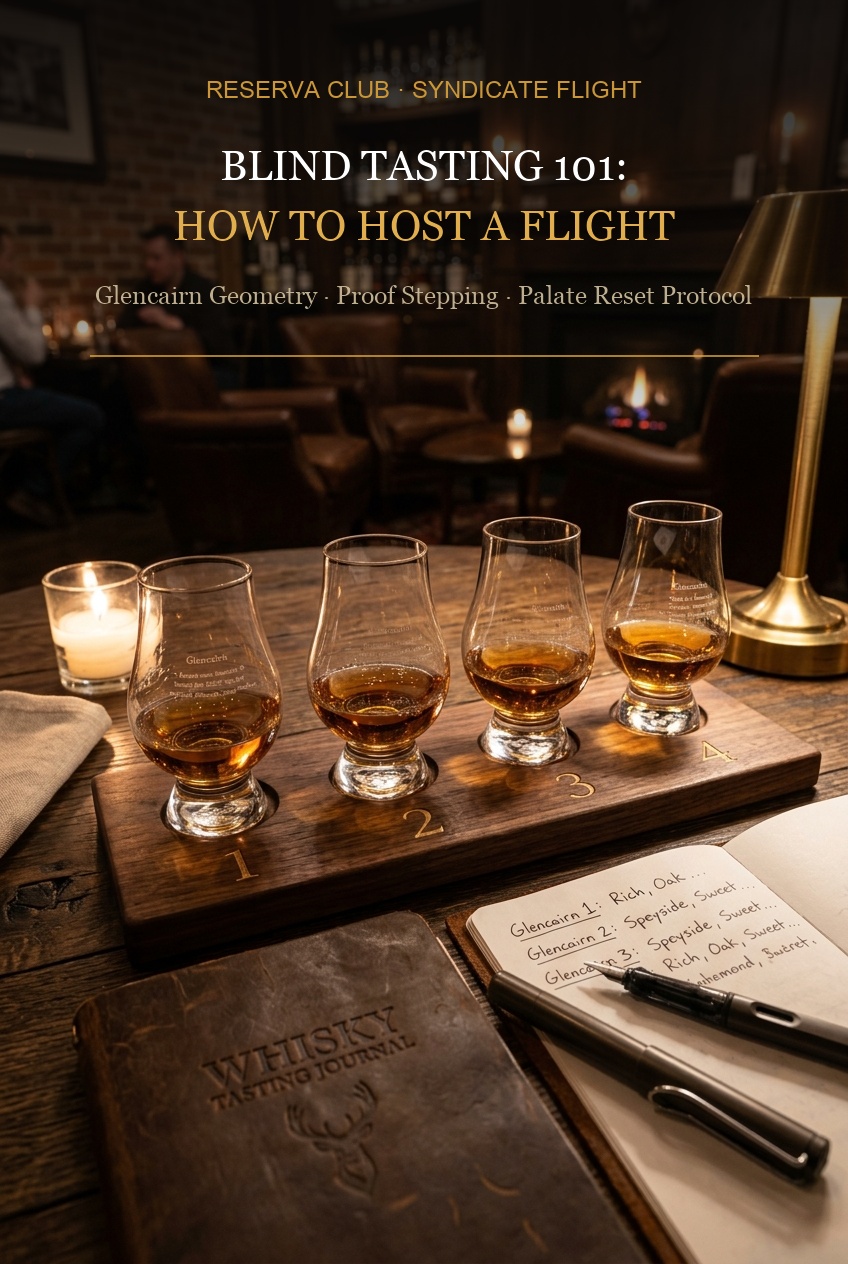
If your flight features bottles of varying proof points, you must arrange the flight in strictly ascending proof order:
Glass 1: 90 Proof (45% ABV)
   │
Glass 2: 100 Proof (50% ABV)
   │
Glass 3: 110 Proof (55% ABV)
   │
Glass 4: 125 Proof (62.5% ABV)
Tasting from lowest proof to highest proof protects the palate against early ethanol shock. Alternatively, hold the flight within a tight 5-proof band (e.g., all samples between 98 and 103 proof) to test flavor extraction without proof distraction.
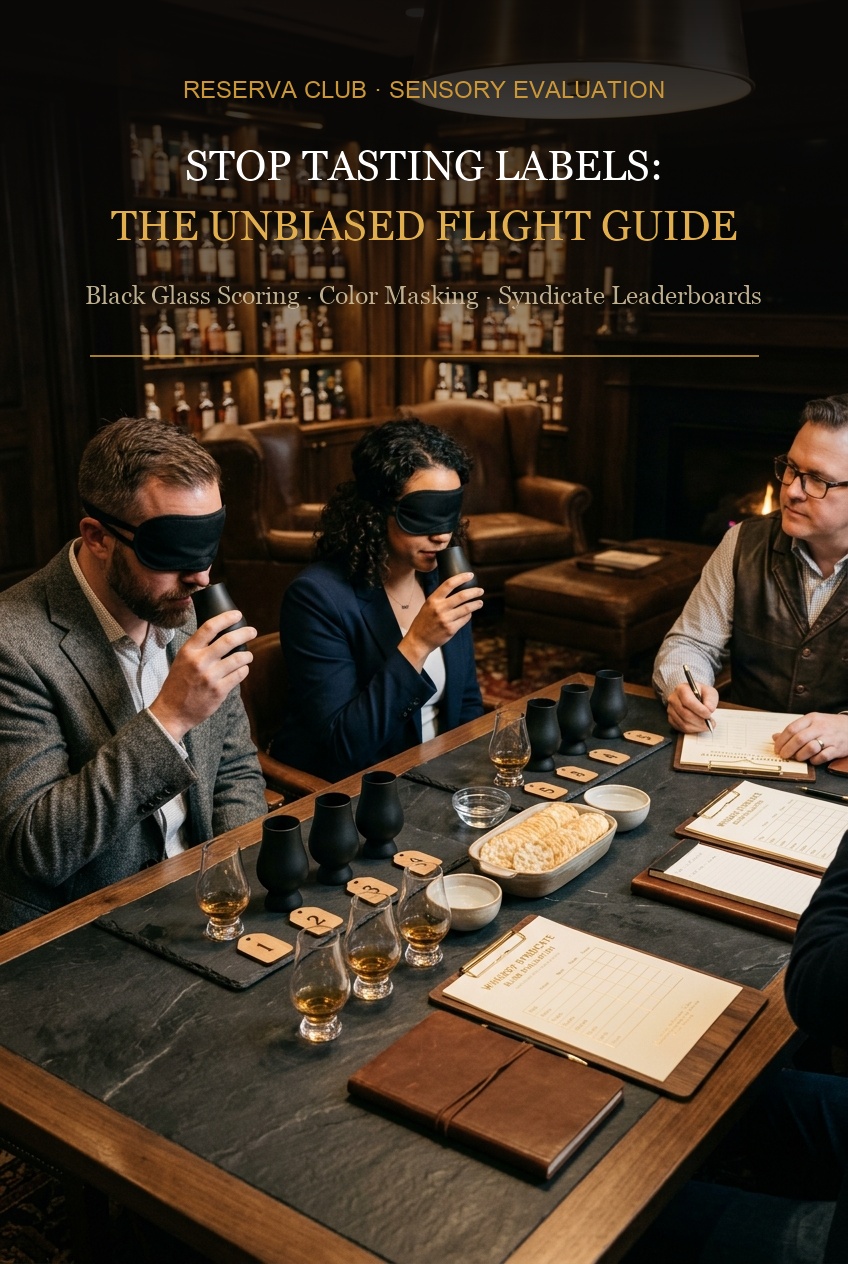
Hardware & Methodology: The Double-Blind Setup
A blind tasting is only as credible as its administrative security. If the host knows which glass contains the expensive unicorn bottle, body language and subtle cues will subconsciously influence the room.
The gold standard is the Double-Blind Protocol:
[ Person A: Pours Bottles ] ──► Labels Glasses with Hidden Code: [A, B, C, D]
                                      │
[ Person B: Randomizes Order ] ──► Re-labels Flight Boards: [1, 2, 3, 4]
                                      │
                                      ▼
                        [ NOBODY KNOWS THE KEY ]
                    (Sealed in Envelope Until Reveal)
1. Identical Crystal Glassware
Every participant must drink from identical glassware. Never serve Glass 1 in a Glencairn and Glass 2 in a rocks tumbler. Glass geometry dictates how aromatic vapor concentrates:
- Use standard Glencairn crystal glasses. The tulip shape funnels heavy alcohol vapor out while concentrating sweet esters at the rim.
- Ensure all glasses were washed in fragrance-free detergent and air-dried. Residual rinse-aid or fabric-softener odors from kitchen towels will ruin a flight.
2. Color Masking (The Visual Illusion)
Deep mahogany, reddish-amber whiskey tricks our brain into assuming ancient barrel age and rich extraction. A pale golden pour is automatically pre-judged as young and thin.
To eliminate visual bias:
- Use The Official Glencairn Blind Tasting Matte Black Crystal Glasses, or
- Dim the tasting room lighting to low candlelight, or
- Blindfold tasters during the initial nosing evaluation.
Sensory Palate Reset Protocols
Between high-proof samples, your oral mucosa dehydrates and your taste buds become coated in wood tannins and corn oils. Gulping cold ice water or eating spicy snacks will destroy your palate.
Use the three proven Sensory Reset Tools:
1. Room-Temperature Neutral Mineral Water
Never use ice-cold water. Cold temperatures constrict the blood vessels of the tongue and numb taste receptor cells. Use room-temperature spring or mineral water (such as Fiji or Acqua Panna) with a neutral pH (~7.2) and low minerality. Rinse your mouth and swallow between pours.
2. Unsalted Water Crackers
Keep bowls of plain, unsalted water crackers such as Carr's Table Water Crackers Palate Cleansers on the table. The dry starch acts as a physical squeegee, absorbing residual oils from the tongue without introducing salt, butter, or sugar that would alter subsequent whiskey sips.
3. Olfactory Reset (Resetting the Nose)
If your nose feels fatigued after sample 3, do not sniff ground coffee beans—coffee is an overwhelming volatile aroma that replaces one olfactory overload with another.
- The Connoisseur's Reset: Sniff your own clean skin (the crook of your elbow or the back of your wrist, free of cologne or lotion). Your olfactory system recognizes your own baseline body odor as "neutral zero," immediately resetting your scent receptors.
The 100-Point Connoisseur Scoring Framework
Provide each taster with an identical scorecard. Evaluating whiskey across four structured parameters forces participants to judge structural quality rather than vague gut feelings:
| Parameter | Max Points | Evaluation Criteria |
|---|---|---|
| The Nose | 25 Pts | Aromatic complexity, depth of fruit/wood/grain, absence of harsh acetone or ethyl acetate solvent notes |
| The Palate | 35 Pts | Texture, viscosity, coating ability, flavor evolution across front, mid, and back palate |
| The Finish | 25 Pts | Length of finish, lingering sweetness vs. dry bitterness, warmth vs. harsh chest burn |
| Balance & Structure | 15 Pts | Integration of alcohol proof with wood tannins; does the whiskey feel cohesive or disjointed? |
| TOTAL | 100 Pts | 90+ = Exceptional / 80-89 = Solid Daily / <80 = Flawed |
The Dramatic Reveal: How to Unmask the Flight
The climax of any blind tasting is the Reveal Ceremony:
- Lock the Scores First: All participants must finalize their numerical rankings and write down their predicted identity of each sample before any discussion begins. Once someone says "Sample 2 tastes like Buffalo Trace," groupthink will taint the room.
- The Prediction Round: Go around the table. Have each taster declare their favorite pour, their least favorite pour, and their guess for the allocated unicorn bottle.
- The Unmasking: Open the sealed envelope and reveal the bottles in reverse order (from lowest ranked to highest ranked).
Almost without fail, a blind tasting produces jaw-dropping surprises: an allocated $500 secondary bottle finishes third behind a $45 widely available store pick, while an overlooked 100-proof Bottled-in-Bond takes crown champion.
Recommended Blind Tasting Hardware & Evaluation Gear
To host a professional, unbiased blind tasting flight for your private tasting circle or syndicate:
- Opaque Blind Tasting Glasses: The Official Glencairn Blind Tasting Matte Black Crystal Glasses — Black opaque finish completely eliminates visual color bias, masking spirit age and barrel char.
- Standard Glencairn Flight Set: Official Glencairn Crystal Whiskey Glasses (Set of 6) — Identical glassware standardizes aromatic vapor concentration across all tasting stations.
- Hardwood Flight Board: Handcrafted Solid Walnut 4-Glass Whiskey Flight Board — Numbered flight paddle keeps blind samples organized in strictly ascending proof order.
- Palate Cleansing Crackers: Carr's Table Water Crackers Palate Cleansers — Unsalted, unflavored water biscuits to reset tongue papillae and absorb lingering alcohol oils.
- Leather Bound Tasting Journal: Refillable Full-Grain Leather Tasting Journal — Archival leather notebook to record blind scores, proof predictions, and distillery reveals.
- Classic Fountain Pen: Lamy Safari Charcoal Fountain Pen — Smooth fountain pen for logging detailed sensory scores and tasting deduction notes.
Frequently Asked Questions
What proof range is best for a beginner blind tasting?
For tasters new to blind flights, stick to the 90 to 100 proof range (45%–50% ABV). This provides ample flavor concentration and oak character without overwhelming unconditioned palates with alcohol heat.
How much whiskey should be poured into each Glencairn?
Pour exactly 0.75 oz to 1.0 oz per glass. This provides sufficient volume to swirl, nose, and take three separate sips without leaving excess spirit to evaporate or oxidize during the tasting.
How long should you let the glasses rest before tasting?
Allow the flight to rest in the glasses for 10 to 15 minutes before nosing. This allows the high-velocity ethanol vapor that collects in the glass neck during pouring to dissipate, revealing the delicate ester and lactone layers beneath.
Organize Your Tasting Circle on Reserva Club
Blind tastings are the heartbeat of the Reserva Club Private Syndicate. Inside Reserva Club, you can form private collector syndicates, share bottle splits, log blind flight scorecards, and compare community cellar rankings with fellow connoisseurs across the country.
More from The Codex
Habano Wrappers & Cask-Strength Rye: Why Peppery Leaf Cuts High Proof
Read Guide →The Truth About Finishing Casks: Sherry, Port, Cognac, and Toasted Oak Staves
Read Guide →Tobacco Beetles (Lasioderma serricorne): Identification, Freezing Protocol, and Cellar Quarantine
Read Guide →The Connecticut Shade Morning Ritual: Pairing Mild Cigars with Espresso & Wheated Bourbon
Read Guide →Wheated vs. High-Rye Bourbon: Decoding Mashbills, Palate Weight, and Finish
Read Guide →How to Calibrate a Digital Hygrometer: The 75% Salt Test vs. Boveda One-Step
Read Guide →
Smoke · Sip · Savor
Track your bottles, fill levels, infinity blends, and real street valuation.
Open My Whiskey Shelf →Reserva Club is reader-supported. When you purchase through links on our site, we may earn an affiliate commission at no extra cost to you. As an Amazon Associate, we earn from qualifying purchases.