
Dry-Boxing 101: How 24 Hours Before Lighting Fixes Tight Draws, Tunneling & Canoeing
Why cigars pulled straight from a 68% RH humidor often burn hot, canoe, or go out in the final third—and how staging your cigar in an unhumidified cedar box for 24 hours transforms combustion.
Table of Contents
Have you ever pulled an expensive, beautifully rolled cigar straight out of your humidor, toasted the foot with care, and spent the next hour fighting a plugged draw, uneven "canoeing" burn lines, or a stick that refuses to stay lit in the final third?
Most smokers blame the roller in Estelí or Santiago. In reality, 90% of burn failures happen because the cigar was smoked at storage humidity rather than smoking humidity.
Tobacco leaves are hygroscopic sponges. When a cigar sits at 67%–70% RH—or when you order sticks online that were shipped with high-humidity packs—the thick internal filler leaves hold excess moisture. Light that cigar immediately, and the cherry boils that trapped water into bitter steam, swelling the filler and choking off your draw.
The solution used by master blenders and lounge sommeliers is simple, free, and transformative: Dry-Boxing.
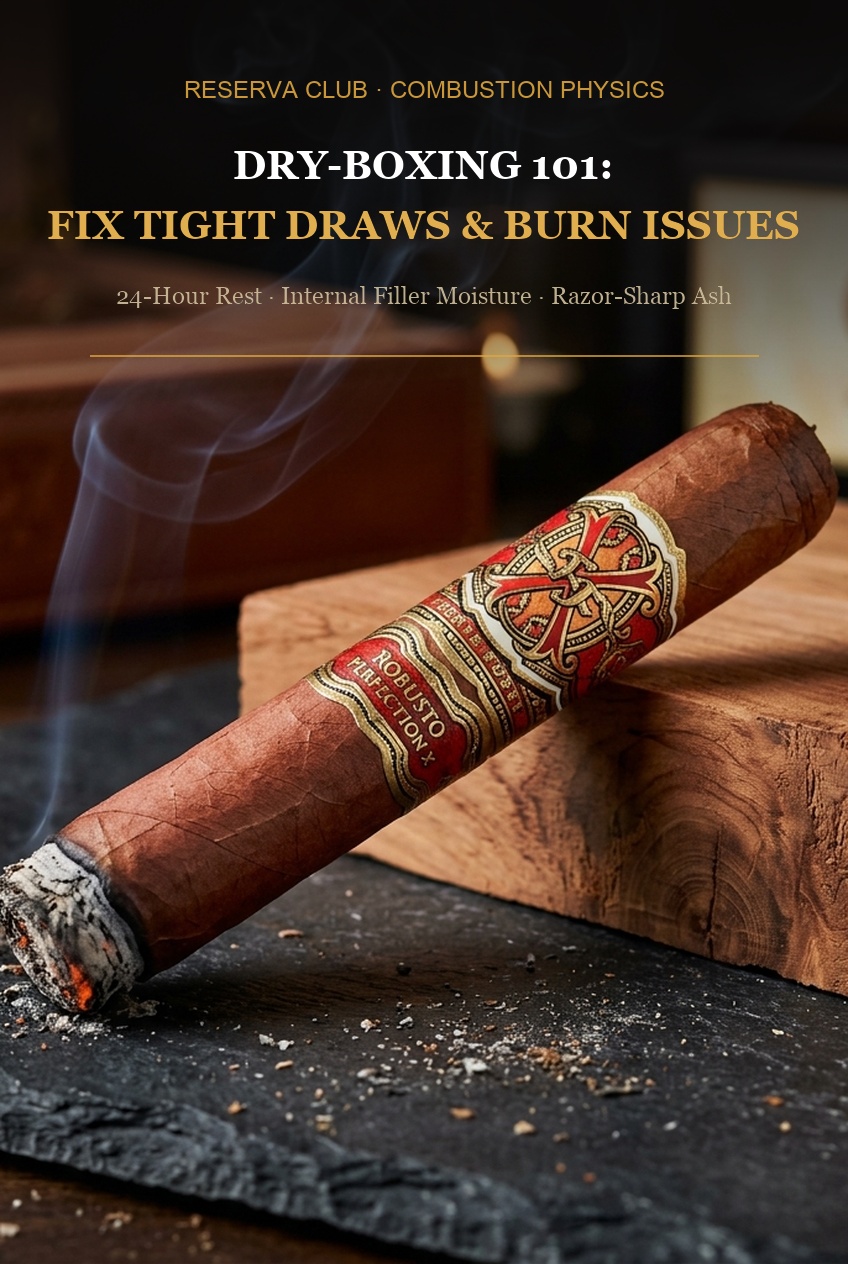
The Combustion Physics of Dry-Boxing
Dry-boxing is the practice of removing a cigar from your primary humidor 12 to 48 hours before you plan to smoke it and placing it inside an empty, unhumidified wooden cigar box or Spanish cedar travel tray.
Here is what happens inside the cigar during those 24 hours:
- Surface Moisture Equalization: The unseasoned Spanish cedar box gently wicks 2% to 4% of excess free water molecules out of the outer wrapper and binder without stripping the slow-evaporating essential tobacco oils.
- Filler Contraction & Airflow Opening: As the internal ligero and seco leaves shed excess dampness, the tobacco fibers contract slightly—opening microscopic air channels from the foot to the cap. A tight draw becomes effortless.
- Cooler Ember Temperature: Because you don't have to double-puff to keep damp tobacco lit, the combustion zone burns 100°F to 150°F cooler, preserving delicate notes of cream, cedar, cocoa, and roasted nuts instead of charring them into tar.
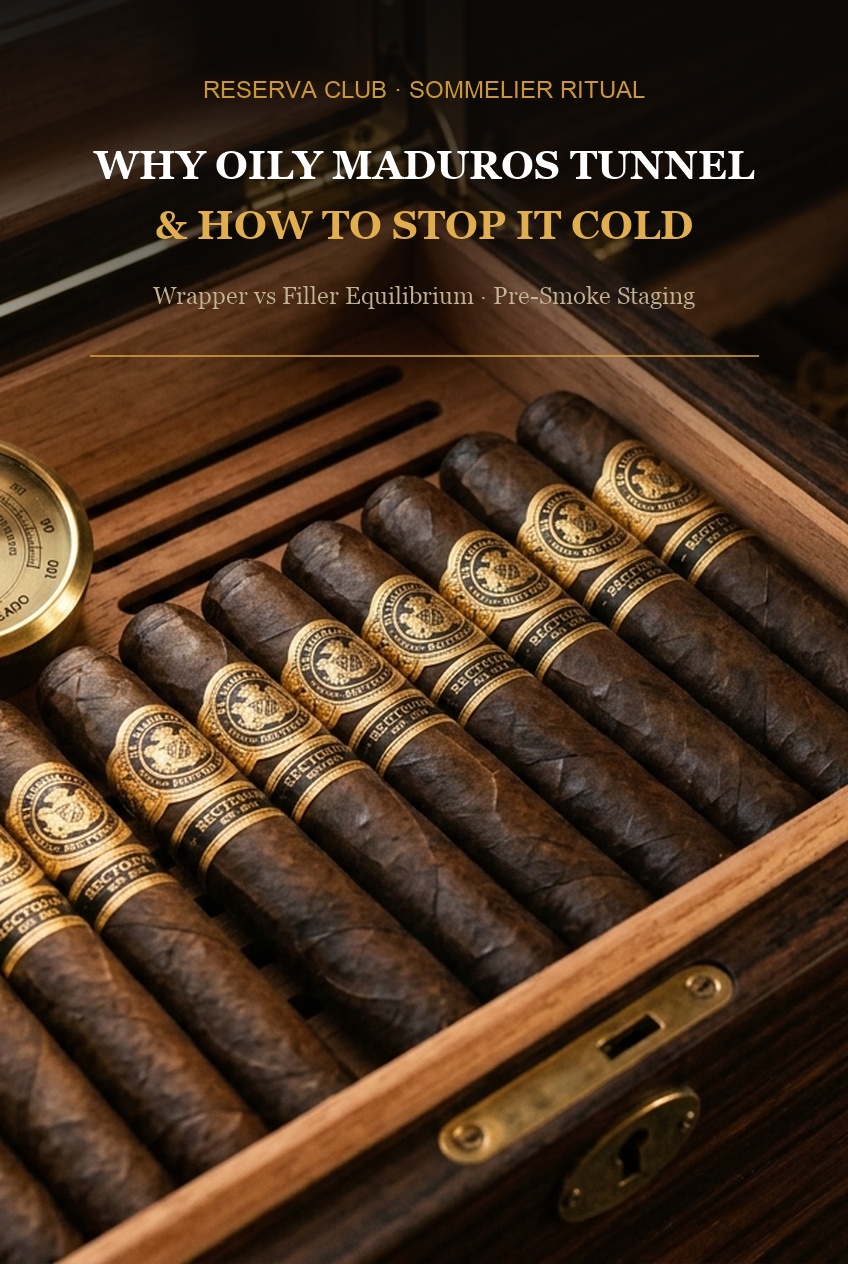
Which Cigars Benefit Most from Dry-Boxing?
While a thin, dry Camaroon or mild Connecticut stored at 63% RH can be smoked right out of the humidor, three categories of cigars transform completely when dry-boxed:
| Cigar Style | Examples | Ideal Dry-Box Time | Why It Needs Staging |
|---|---|---|---|
| Thick Oily Broadleaf / Maduro | Liga Privada No. 9, Foundation Tabernacle, Padrón Maduro | 24 – 36 Hours | Thick, fermenting-oil-rich wrappers burn slower than the filler; dry-boxing prevents tunneling |
| Small Ring Gauge / Perfectos | Arturo Fuente Hemingway Short Story, Lanceros (38–42 RG) | 12 – 24 Hours | Narrow ring gauges pack tobacco tightly at the taper; dropping RH by 3% opens the draw |
| Fresh Retail / Brick & Mortar Buys | Walk-in lounge humidors kept at 70%–72% RH | 24 – 48 Hours | Retail walk-ins over-humidify to offset door traffic; smoking right off the shelf tastes harsh |
The Step-by-Step Dry-Boxing Protocol
Step 1: Dedicate an Empty Spanish Cedar Box
Never leave a cigar sitting naked on a kitchen counter—moving a stick directly from a 66% RH humidor into a 35% RH air-conditioned or heated room will shock the outer wrapper and cause it to crack while the center stays wet. Instead, use an empty dress cigar box or a dedicated Spanish Cedar Desktop Cigar Box with no Boveda packs inside. The wood slows the moisture drop so the wrapper and filler dry evenly.
Step 2: Remove the Cellophane
Before placing tomorrow's cigar into your dry-box, slide it out of its cellophane sleeve. Cellophane is semi-permeable, so leaving it on slows down 24-hour moisture equalization by roughly 70%.
Step 3: Perform the Pinch Test & Precision Cut
After 24 hours in the dry-box, gently roll the foot of the cigar between your thumb and index finger. It should feel firm and resilient with a faint oil sheen—never spongy or mushy. Make a clean cut with a razor-sharp Colibri Deep V-Cut Cigar Cutter or Xikar Xi2 Double Guillotine Cutter and test the cold draw before lighting.
Frequently Asked Questions
What if I live in a very humid climate (65%+ indoor house humidity)?
If your home sits above 65% RH in the summer or in coastal/rainy climates, an empty wooden box won't pull moisture out of your cigar. In high-humidity climates, place a single Boveda 58% or 62% RH 2-Way Humidity Pack inside a small airtight travel container to actively draw excess moisture down before smoking.
What if my cigar is plugged even after dry-boxing?
Occasionally a cigar has a physical "knot" of twisted tobacco stems near the band. Instead of tossing a $20 stick, use a precision draw tool to gently core a narrow airflow channel through the center without cracking the wrapper.
Log Your Cigar Burn & Draw Scores in Reserva Club
Want to remember which vitolas in your humidor smoke best at 65% RH versus a 24-hour dry-box? Log your cigars and tasting sessions in Reserva Club to build your personal cellar playbook.
More from The Codex
The Neck Pour Myth: How Headspace Oxidation Changes High-Proof Bourbon Over 90 Days
Read Guide →The Tupperdor Blueprint: Why Airtight Acrylic & 62% Boveda Beat Cheap Wood Humidors
Read Guide →Blind Tasting 101: How to Host an Unbiased Whiskey Flight at Home
Read Guide →Habano Wrappers & Cask-Strength Rye: Why Peppery Leaf Cuts High Proof
Read Guide →The Truth About Finishing Casks: Sherry, Port, Cognac, and Toasted Oak Staves
Read Guide →Tobacco Beetles (Lasioderma serricorne): Identification, Freezing Protocol, and Cellar Quarantine
Read Guide →
Smoke · Sip · Savor
Ready to track your cigars, aging dates, and humidor collection?
Start My Digital Humidor →Reserva Club is reader-supported. When you purchase through links on our site, we may earn an affiliate commission at no extra cost to you. As an Amazon Associate, we earn from qualifying purchases.